 Contents
In pneumatic systems, when actuators operate slowly or fail to meet the required cycle time, technicians often instinctively increase the overall system pressure or switch to valves with a higher flow coefficient (Cv). However, the root cause is often localized pressure drops or insufficient peak flow at the end point of the system.
Limitations of Conventional Pressure Increase Approaches
Before considering a booster regulator, many engineers typically try:
- Raising the overall system pressure, which affects all components and can shorten their service life
- Using larger cylinders, which take up more space and increase mechanical costs
- Redesigning the transmission mechanism, which requires time and additional investment
While these approaches are not inherently wrong, they are not always optimal—especially for systems that are already stable and in operation.
When to Use a Booster Regulator
In real-world factory environments, situations like the following are quite common:
- Cylinders fail to generate sufficient clamping force despite adequate system pressure
- Certain processes require higher force, but increasing pressure across the entire system is not feasible
- Machines are limited by existing pneumatic infrastructure (piping, compressors, etc.)
- Upgrading the entire system to achieve higher pressure is too costly and complex
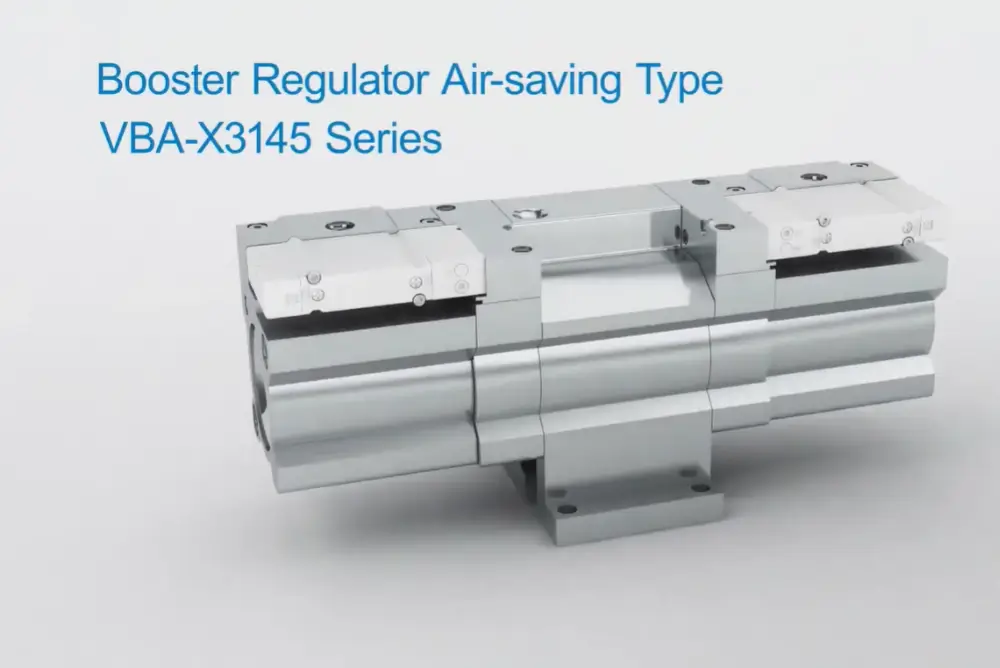
In these cases, the challenge is not increasing pressure system-wide, but boosting it locally where needed. The VBA Series Booster Regulator from SMC provides an effective and practical solution. It increases pressure without requiring changes to system design or upgrades to the central air compressor capacity. Instead of forcing the entire system to operate at a higher pressure, you can selectively boost pressure at specific points-such as clamping, pressing, holding, or short-duration processes that demand higher force.


Working Principle of the SMC VBA Booster Regulator
The VBA booster regulator operates without electricity or complex mechanisms. It uses the existing compressed air supply to amplify pressure.

When compressed air enters the unit, part of it is used to drive an internal piston. This piston reciprocates continuously, controlled by an integrated switching valve mechanism.
During operation, air is drawn into a chamber and then compressed into a smaller volume, increasing its pressure before being discharged. This cycle repeats rapidly, allowing the outlet pressure to exceed the inlet pressure—typically up to twice as high, or more depending on the model. It’s important to note that the VBA does not generate new energy; it simply converts flow into pressure. As pressure increases, flow rate decreases accordingly. Additionally, due to its piston-based operation, the output airflow is not perfectly continuous and may exhibit slight pulsation and vibration during operation.
Key Benefits
Rapid pressure boost: Increases output pressure to approximately twice the inlet pressure (model-dependent), improving clamping, pressing, and holding force without impacting other parts of the system.
No electrical power required: Fully pneumatic operation makes it ideal for industrial environments with strict safety requirements.
Compact and easy to integrate: Can be installed directly into existing systems, unlike replacing large cylinders or valves.
Cost-effective: Eliminates the need to upgrade compressors or overhaul piping systems, significantly reducing investment costs.
Applications
In practice, VBA booster regulators are commonly used for:
- Increasing clamping force in jigs and fixtures
- Press-fitting operations in assembly processes
- Holding workpieces securely during machining
- Compensating for pressure loss at the end of long air lines
- Applications requiring high force over short durations


Important Considerations for Use
To ensure optimal performance, proper piping and installation conditions are essential. When selecting a VBA unit, consider the required outlet pressure, flow rate, and operating cycle. The inlet air pressure must be at least 0.2 MPa. It is recommended to install an air filter upstream and consider adding a mist separator or fine filter at the outlet if necessary. Use appropriately sized tubing that matches the valve ports, and ensure sufficient space for maintenance. Since the VBA operates with a reciprocating piston mechanism, vibration will occur during operation. Therefore, the unit should be securely mounted using four bolts with the correct tightening torque. These details may seem minor, but they play a critical role in ensuring system stability and long-term performance.
As an authorized distributor of SMC Corporation in Vietnam, Temas not only supplies genuine products but also provides expert consultation to help you select the right model, support system design, and optimize your pneumatic setup. Contact Temas today for in-depth technical support.
Explore more SMC products for your applications


 Read more