 Contents
Customer Background and Requirements
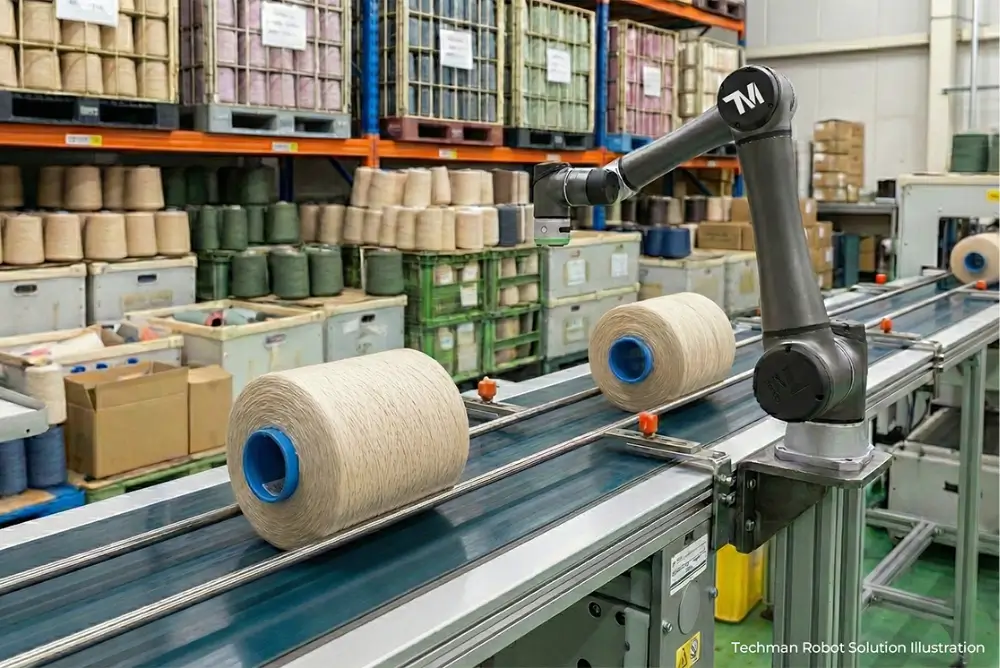
The customer in this case study is a large-scale manufacturer of woven material rolls, supplying products to a wide range of industrial applications. Among them, woven fabrics used for automotive airbags stand out as a product line with exceptionally stringent requirements for safety, consistency, and surface defect control.
Under increasing pressure from automotive industry standards, the customer set a clear objective: upgrade their quality inspection process, reduce reliance on manual inspection, and improve overall product stability. The challenge was not only to detect defects, but also to accurately identify extremely small flaws on fabric surfaces with complex woven structures.
Challenges Faced
Inspecting woven fabrics for automotive airbags presents significant challenges for conventional inspection systems:
- Highly diverse defects: Issues such as loose fibers, protruding yarns, or uneven surfaces vary continuously in shape and size, with no fixed pattern.
- Visual noise interference: The woven structure and rolled fabric create highly textured backgrounds, making it difficult to distinguish normal material characteristics from actual defects.
- Focusing difficulties: When inspecting the side surface of cylindrical fabric rolls, curved edge areas often fall out of focus, increasing the risk of missed defects.
- Inconsistent data labeling: Differences between human judgment and AI predictions complicate the creation of a standardized and reliable training dataset.
Implemented Solution
To address these challenges, the project team deployed a Proof of Concept (PoC) combining a collaborative robot, an industrial vision system, and Techman Robot’s AI-based defect detection technology.

The system utilized a high-resolution industrial camera paired with optimized lighting, positioned to observe the side surface of the woven fabric roll at an appropriate distance. During evaluation, the engineering team found that AI performance was highly dependent on proper mechanical design support.
Specifically, static image capture could not ensure that the entire roll surface remained within the camera’s depth of field. As a result, a rotating mechanism for the fabric roll was proposed and integrated. This allowed each surface area to sequentially pass through the camera’s focal zone, significantly improving defect detection accuracy.
On the software side, the AI model was trained using a dataset containing a wide variety of defect types. The Auto AI Training feature was leveraged to enable the system to automatically collect additional NG samples, substantially reducing false positives in visually noisy environments.
Achieved
Laboratory testing demonstrated that the solution delivered clear and practical benefits:
- Accurate defect detection: The AI reliably identified surface defects on woven fabrics, even against highly complex backgrounds.
- Reduced confusion with fabric texture: The system clearly distinguished normal weaving patterns from real defects, minimizing false positives.
- Clear mechanical design requirements: The trials confirmed that combining AI with a roll-rotation mechanism effectively eliminated missed defects caused by blur or focus drift.
- Future scalability: Auto AI Training allows the system to continuously learn and adapt to new defect types, ensuring long-term operational stability.
This case study highlights that AI-based quality inspection for automotive airbag fabrics is a highly effective approach, particularly for materials with complex surfaces and strict reliability requirements. The success of the solution lies not only in Techman’s AI algorithms, but in the seamless integration of machine vision, mechanical design, and a well-defined data training strategy.

Temas is the authorized distributor of Techman collaborative robots in Vietnam and brings extensive experience in deploying robotics, AI vision, and factory automation solutions. If your business is looking for an intelligent, flexible, and scalable quality inspection solution, feel free to contact us, Temas is ready to partner with you to develop the most suitable approach for your production line.



 Read more
![MOON LIFTER - SUCCESS STORY OF ONCHI SHOKUHIN CO., LTD. [KYOTO]](https://temas.vn/public/filemanage/Case Stories/Unipulse/Moon Lifter/cau_chuyen_thanh_cong_moon_lifter_3.jpg)