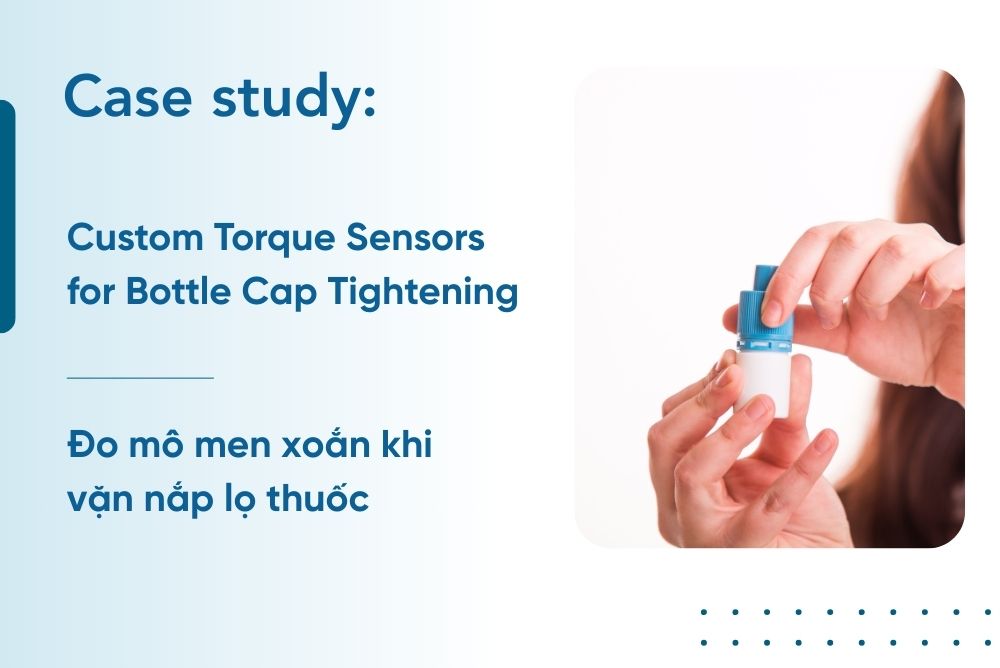
In the pharmaceutical and nutraceutical industries, cap tightening torque is a critical quality control parameter. Caps that are too tight are difficult for end users to open, while caps that are too loose can compromise sealing integrity, safety, and product shelf life. For factory engineers, the challenge is clear: how to measure cap torque accurately under conditions involving non-standard product shapes, limited installation space, and strict requirements for repeatability and precision.

The challenge
In pharmaceutical production lines, cap tightening torque directly affects:
- Packaging seal integrity, preventing leakage and air ingress
- User experience when opening the product
- Consistency across products within the same batch
- Compliance with internal quality standards and pharmaceutical regulations
As a result, many manufacturers move beyond random checks with handheld testers. They require quantitative torque measurement with recorded data and the ability to integrate results into their quality control processes

Unlike conventional shaft torque measurement, measuring torque during bottle cap tightening presents several technical difficulties:
- The product geometry is not a standard cylindrical shaft
- Small dimensions leave very limited space for sensor installation
- The measurement must realistically reproduce actual tightening conditions by hand or by machine
- The cap and bottle must not be deformed during measurement
Standard torque sensors are often unsuitable for direct attachment to bottle caps or containers, leading to installation challenges and measurement errors.
Solution: Sensors designed to match the actual product shape
Unipulse, a Japanese manufacturer specializing in force, weight, and torque measurement, proposes a different approach: designing a sensor whose shape closely replicates the actual product.
In this solution, the sensor is manufactured to resemble an eye-drop bottle, matching the real product geometry. Inside the simulated bottle body, strain gauge are integrated. When the cap is tightened, the applied torque acts on the sensor body and is captured directly by the strain gauge.

This approach enables torque measurement under conditions that closely replicate real use, including manual tightening. Key parameters such as torque per tightening cycle and maximum torque can be measured accurately.


Watch the solution in action:
Despite its customized shape, this sensor is fundamentally based on strain gauge technology:
- Cap tightening generates torsional stress on the sensor body
- Minute mechanical deformation is converted into an electrical signal by the strain gauges
- The signal is amplified and transmitted to a display unit or data acquisition system
The key distinction lies in the mechanical design. Instead of a standard shaft structure, the sensor body is optimized in shape to accurately reproduce the mechanical behavior of a real pharmaceutical bottle.
Read more: What is a strain gauge sensor? Comparison between strain gauge and piezoelectric sensors.
Easy data access and integration
Measured values are displayed in real time on an indicator, allowing operators to monitor results easily. Measurement data can also be logged and transmitted to a PC or PLC for analysis, traceability, and quality management.

Applications in manufacturing
Beyond pharmaceutical bottles, Unipulse can manufacture sensors in various customized shapes to match real products such as nutraceutical containers, caps, and closures. Sensor geometry can be tailored to suit the product, available installation space, and actual measurement workflow.
This torque measurement solution is particularly suitable for:
- Quality control: measuring tightening and opening torque, evaluating product consistency, setting OK or NG thresholds based on real data.
- Research and development: evaluating new cap designs, comparing materials for caps, seals, and threads, optimizing opening feel for end users
- Evaluation of automatic capping equipment: verifying actual torque applied by machines or capping mechanisms and fine-tuning machine parameters based on measured data.

The sensor can perform measurements while being put in the production line with actual product
Temas is an authorized distributor of Unipulse force, weight, and torque measurement products in Vietnam. Temas also provides consulting, machine design, and turnkey automation solutions. For applications involving force, torque, or strain measurement in confined spaces, on products with special geometries, or in cases where standard torque sensors are not feasible, please contact us.



 Read more
![MOON LIFTER - SUCCESS STORY OF ONCHI SHOKUHIN CO., LTD. [KYOTO]](https://temas.vn/filemanage/Case Stories/Unipulse/Moon Lifter/cau_chuyen_thanh_cong_moon_lifter_3.jpg)