 Contents
- How GMW Accelerates R&D for EV and Drone Motors
- Challenges of Traditional Motor Prototyping
- GMW Advantage
- DFM Validation: A Critical Bridge from Design to Production
- Case Studies: Premium EV Traction Motors and Robotic Joint Modules
- Case 1: EV Drivetrain Project – High Slot Fill Traction Motor Line
- Case 2: Robotics Application – Joint Module Development
- Key Application
In today’s highly competitive high-tech markets, shortening time to market has become a top priority, especially in fast-growing technology hubs like Vietnam. GMW’s Motor Prototype Service, which supports motor design, manufacturing, and validation during the R&D phase, was developed to help R&D teams working on EV motors, drone motors, and robotic servo motors accelerate development while ensuring a smooth, consistent transition to mass production.
How GMW Accelerates R&D for EV and Drone Motors
According to market forecasts, the global electric motor market is expected to reach USD 258.17 billion by 2032, with a compound annual growth rate (CAGR) of 7.52%. Despite this strong growth outlook, many R&D teams face major obstacles—particularly the high upfront investment required for specialized winding equipment and the long development cycles typically associated with motor prototyping.

GMW’s Motor Prototype Service is designed to directly address these challenges. By providing production-ready winding infrastructure, GMW enables EV and drone motor projects—especially those requiring high power density—to significantly reduce development and manufacturing time. This advantage is particularly valuable in Western markets, where performance and reliability requirements are exceptionally stringent.
Challenges of Traditional Motor Prototyping
In a conventional development approach, companies often need to invest heavily in winding machines, tooling, and fixtures. This process is not only time-consuming but also carries a high risk of mismatch between prototype conditions and actual mass-production conditions. As a result, new issues often emerge during final validation or production ramp-up, directly impacting motor performance and operational stability.
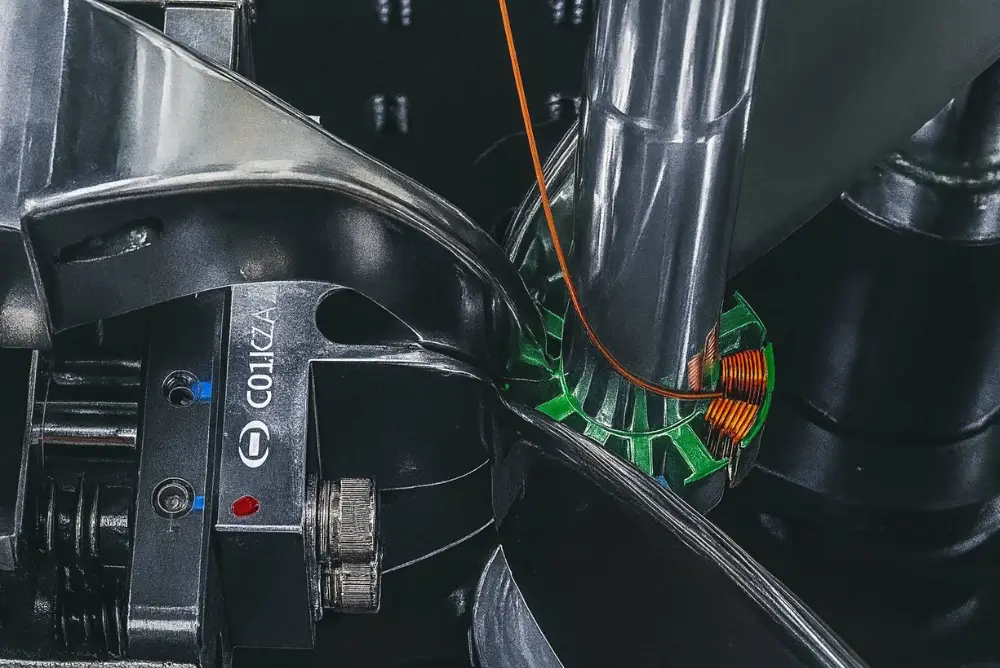
Compared with manual winding, GMW’s automated winding systems deliver a clear advantage. Instead of relying heavily on skilled labor, automated winding ensures consistent, high-efficiency production and can reduce the time needed to produce an initial prototype to just a few hours. While the initial investment cost is higher, the high yield rate allows payback to be achieved in approximately 18 months.
Another critical advantage lies in data availability. Manual winding offers little to no capability for capturing process parameters, whereas GMW’s winding equipment is integrated with PLC systems that record all winding parameters. This enables full data traceability, fault analysis, and quality control at a level suitable for mass production.
GMW Advantage
With years of experience in designing and manufacturing motor winding equipment, GMW approaches Motor Prototype services with mass production as the ultimate goal—right from the design stage. This philosophy helps eliminate unnecessary costs and delays caused by designs that are not production-ready.

Customers can launch R&D projects without investing capital in dedicated winding machines, allowing them to focus entirely on motor design and testing. Prototype stators are manufactured on equipment equivalent to mass-production systems, ensuring that the quality and stability of the first prototype accurately reflect real production conditions. This approach significantly reduces project risk for EV and robotic servo motor applications and can shorten overall project timelines by weeks or even months by eliminating additional validation loops.
DFM Validation: A Critical Bridge from Design to Production
Design for Manufacturability (DFM) validation acts as a form of technical insurance, increasing the success rate of EV and robotic servo motor projects as they move into mass production.
Key factors include evaluating the relationship between wire diameter and slot width, achievable winding density, and realistic slot fill factor. In addition, coil end geometry, potential interference, and the feasibility of automated wire insertion must be verified early in the development process.
For high-value applications such as EV and drone motors, optimizing winding performance and slot fill factor is a core strategy for maximizing BLDC motor efficiency.

Case Studies: Premium EV Traction Motors and Robotic Joint Modules
Case 1: EV Drivetrain Project – High Slot Fill Traction Motor Line
In this project, GMW partnered with an EV drivetrain manufacturer targeting the international market, with the goal of developing a high-performance traction motor for a new generation of electric vehicles. The project scope included building a complete automated winding line for EV traction motor stator prototypes.
The stator featured an inner diameter of 200 mm, an outer diameter of 300 mm, and a three-phase winding structure. The primary challenge was achieving an 86% slot fill factor using rectangular wire under mass-production conditions—a highly demanding target and one of the industry’s leading benchmarks. The line integrates all key processes, including insulation paper insertion, straight-drop winding, wire insertion and phase forming, coil shaping, and lacing, along with heavy-load stator fixtures and optimized material handling.
The line is now operating stably, demonstrating GMW’s strong capabilities in large, high-power EV traction motor applications with demanding technical requirements.
Case 2: Robotics Application – Joint Module Development
In the robotics sector, GMW has been involved in developing joint modules based on high-precision servo motors, representative of next-generation robotic systems such as quadruped robots.
GMW supported the development of critical motor prototypes while optimizing the winding process using high-precision automated equipment. By providing DFM-focused design consulting from the earliest stages, the validation cycle for high-performance servo modules was significantly shortened.
Key Application
GMW’s Motor Prototype Service plays a vital role in next-generation drivetrains and intelligent systems, transforming design concepts into product advantages validated by real production data.
For electric vehicles, motor prototypes meet stringent requirements for efficiency, torque, and driving range, enabling verification of high slot-fill, low-loss winding solutions that align with EV motor standards.

As the authorized distributor of GMW solutions and equipment in Vietnam, Temas not only supplies products but also partners closely with customers throughout the entire process—from technical consulting and winding technology selection to project implementation and optimization.
With extensive experience across EV motors, robotic servo motors, and high-power motor applications, Temas has a deep understanding of DFM requirements, production stability, and the challenges involved in transitioning from prototype to mass production.
By combining GMW’s technology platform with Temas’ strong local implementation capabilities, customers can significantly shorten product development cycles and gain more effective access to production-ready winding solutions. For detailed consultation on Motor Prototype services, motor winding solutions, or specific project needs, please contact Temas to receive direct support from our experienced engineering team.


 Read more