 Contents
- Challenges in color inspection processes
- Limitations of visual inspection
- Limitations of spectrophotometers
- Operating principles and key features of spectroscopiccameras
- Flexible Vision System
- Vision tools
- Epson RC+7.0 / Vision Guide 7.0
- Practical manufacturing applications
- Integrating spectroscopiccameras into automated production lines
In manufacturing color inspection processes, both quality and consistency are non-negotiable requirements. Epson’s spectroscopiccameras are capable of distinguishing subtle color differences that conventional RGB cameras often fail to detect.
Challenges in color inspection processes
In most factories, color-related inspections are still largely carried out through visual observation. In addition to naked-eye inspection, some manufacturers supplement this with spot measurements using a spectrophotometer. However, these approaches come with several inherent limitations.
Limitations of visual inspection
Visual inspection depends heavily on the skill and condition of technicians or operators. Results can vary with ambient lighting and environmental conditions, and the outcomes cannot be quantified objectively. Training qualified inspectors takes significant time, evaluation standards are often inconsistent between individuals, and inspection results may fluctuate throughout the day due to human fatigue and loss of concentration.

Limitations of spectrophotometers
Spectrophotometers measure color by projecting light onto a very small spot and analyzing only a fixed area. As a result, they cannot evaluate color variations across different regions or inspect large surfaces in a single measurement. When color inspection is required over a wide area, multiple point measurements must be taken individually, each with a fixed measurement size. This makes it impossible to assess the entire surface at once and significantly increases inspection time when many measurement points are needed.
With the Epson spectroscopiccamera, these limitations can be effectively overcome. The camera captures images across 16 spectroscopicbands within the visible range (400–700 nm), delivering a much broader color spectrum than standard RGB cameras and enabling the detection of complex color variations that are often overlooked. For example, a spectroscopiccamera can precisely measure and compare the color spectrum of cosmetic wax molds to identify differences as small as ΔE ≈ 0.1—levels that are difficult for the human eye or even a conventional spectrophotometer to perceive.
*Delta E (ΔE) is a metric used to quantify the visible difference between two colors.

Operating principles and key features of spectroscopiccameras
MEMS-based Fabry–Pérot tunable filter
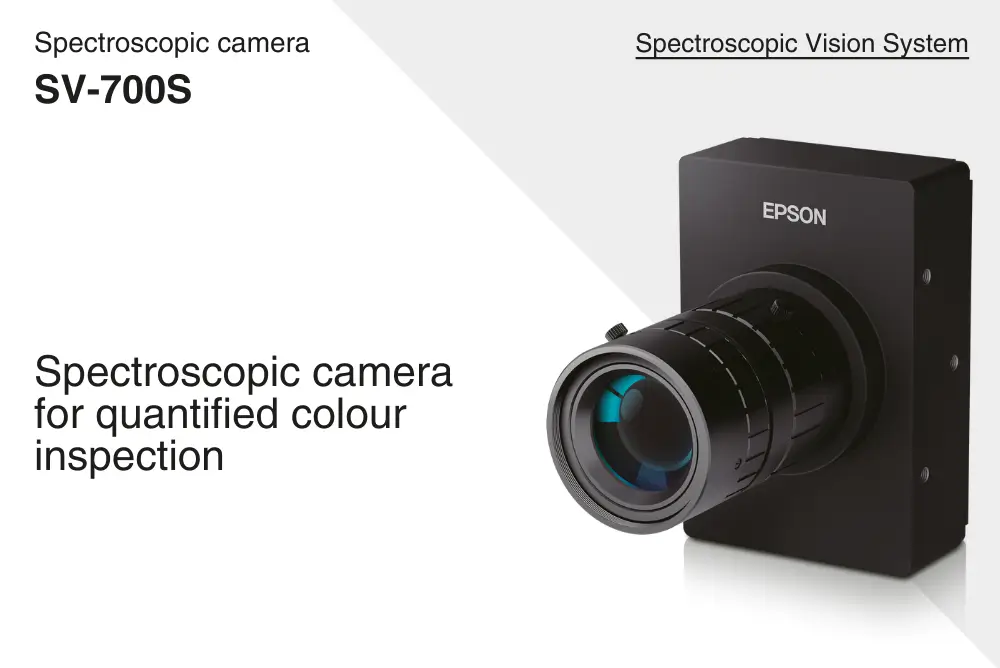
The core technology of the SV-700S is a Fabry–Pérot filter integrated with a MEMS mechanism developed by Epson. This ultra-thin optical filter precisely transmits the desired wavelength with exceptional accuracy and speed. Thanks to the MEMS Fabry–Pérot design, the entire camera is extremely compact—approximately 30 x 49 x 73.5 mm—and weighs only about 175 g.
Despite its small size and light weight, the camera can capture 16 spectroscopicbands at very high speed, requiring only about 2 to 4 seconds per image area, depending on the target object and lighting conditions. Its compact form factor also allows it to be easily installed on production lines, just like a standard industrial camera.

16 wavelength data
*Fabry–Pérot filter: an interference filter that uses light interference created between two parallel reflective surfaces. By adjusting the distance between these reflective surfaces, the transmitted wavelength can be precisely controlled.

High-speed surface scanning
Spectroscopiccameras can capture spectroscopicinformation across an entire designated surface in a single acquisition. This makes it easy to detect color inconsistencies distributed over the surface—something that is difficult to achieve with a spectrophotometer. There is no need to move the product or scan line by line as with line-scan cameras.

Compact size and lightweight design
With dimensions and weight comparable to industrial RGB cameras, the spectroscopiccamera offers great flexibility in installation. It can directly replace an existing RGB camera or be added as a dedicated color inspection step within a production line.

Flexible Vision System
Addressing the limitations of visual inspection and spectrophotometers
Spectroscopiccameras enable area-based spectroscopicmeasurement, closely mirroring how humans perceive color with the naked eye. Thanks to rapid switching across 16 wavelength bands, the system offers a much wider color gamut than conventional RGB cameras and can reliably distinguish extremely subtle color differences.
POffline and inline inspection software
Spectroscopic Vision Tools is a no-code software package designed specifically for offline color inspection applications.
Vision Guide, on the other hand, is equipped with comprehensive image processing functions, allowing users to build a wide range of color inspection applications for inline automation systems.

Easy integration with Epson robots
The spectroscopiccamera system can be directly integrated with Epson robots. Color inspection and robot control can be programmed simultaneously within the same inline software environment, significantly simplifying the development of automated color inspection systems.

Vision tools
Offline operation software
Users can easily acquire spectroscopicimages using simple mouse operations. The software provides intuitive tools for spectroscopicmeasurement and color analysis, enabling users to register reference color data and evaluate inspection results as OK or NG based on color deviation from the reference sample.
In addition, the software supports both quantitative analysis and visual representation of various color-related inspections. It can also be used to validate inspection conditions before deploying an inline application.
Measurement functions
The live preview function displays real-time images from the spectroscopiccamera. The system can measure reflectance, transmittance, and spectroscopicdata at the pixel level. White balance functionality allows normalization of reflectance or transmittance values and reduces color non-uniformity caused by lens characteristics or lighting conditions.
Analysis functions
The system visualizes and quantifies color information in waveform form and within the Lab color space. OK/NG judgments are made based on color deviations relative to pre-registered reference data. Color deviation distributions are displayed pixel by pixel, enabling micro-level inspection of color inconsistencies.
Inspection areas can also be divided into matrices to evaluate color uniformity at a macro level. In addition, the system supports spectroscopicdiscrimination based on spectroscopicshape. A typical example is fabric inspection, where unwanted backgrounds—such as highlights caused by woven fibers—can be excluded from evaluation.
Epson RC+7.0 / Vision Guide 7.0
Inline operation software
The inline operation software is built on an integrated platform that combines the image processing capabilities of Vision Guide 7.0 with the development environment of Epson RC+7.0. This integration allows vision tasks and motion control to be implemented simultaneously within a single system. A wide range of color inspection functions is supported, giving users the flexibility to develop custom spectroscopiccamera-based inspection applications.
Epson RC+7.0 is used to develop robot-based automation systems, enabling robot programming, image processing, and color inspection to be handled within the same development environment.
Practical manufacturing applications
Cosmetics color inspection
The Epson SV-700S spectroscopiccamera demonstrates clear advantages in cosmetic color inspection. With high sensitivity (ΔE < 0.1), it can immediately detect extremely small color differences between batches of face powder, lipstick, or eyeshadow.
For example, in loose powder inspection, the camera captures the spectroscopicdata of the pressed powder surface and compares it with a reference sample to identify color streaking or non-uniform color distribution. This enables cosmetic manufacturers to ensure consistent color tones across every production batch, exactly as specified in the original design.

Textile quality inspection
In the textile industry, color accuracy and uniformity are critical. spectroscopiccameras can detect off-color fibers or dye variations directly on fabric rolls, including very subtle color stains that are difficult to identify with the naked eye.
Epson has applied spectroscopiccamera technology across consumer products, textiles, and automotive components, enabling automatic measurement and quantification of color differences. This improves product consistency and reduces defect rates. For example, the system can detect a faint off-color stripe on white fabric and automatically reject the defective product.
Inspection of anti-corrosion coatings and painted metal parts
Epson spectroscopiccameras can also inspect colored coatings on metal components. Typical applications include checking decorative metal parts—such as hinges, screws on handbags, or electronic components—to verify correct paint color and uniform anti-corrosion coating coverage.
Spectroscopicimages allow precise comparison to confirm whether sufficient paint or coating has been applied, ensuring that all metal parts are properly protected according to specifications.

Color uniformity evaluation of components
For components with similar colors—such as plastic housings or painted flexible plastic parts—the spectroscopiccamera measures Lab color values for each product and compares them with a standard reference.
Thanks to pixel-level spectroscopicimage analysis, the system can easily detect color deviations within the same product group. These quantitative color values are then used to automatically classify products as OK or NG, eliminating dependence on subjective human judgment.

Integrating spectroscopiccameras into automated production lines
Hardware installation
The SV-700S uses a standard C-mount lens. Engineers simply select and mount an appropriate industrial lens (with suitable field of view and F-number) and fix the camera onto a mounting bracket.
The SV-700S connects to the CV2-SV controller via the supplied dedicated USB cable. The CV2-SV operates on a DC 19–24 V power supply and includes a kink-resistant cable approximately 3 meters long.
Lighting within the inspection area must be stable and uniform—for example, using evenly diffused white LED illumination—since color accuracy is highly sensitive to lighting conditions. Backlighting or diffused lighting is recommended to minimize shadows and color distortion.
Controller and software connectivity
The SV-700S camera connects to Epson’s Spectroscopic Vision controller (CV2-SV). The CV2-SV can control one SV-700S camera and, when used in conjunction with Epson RC+7.0, can also support up to four additional GigE cameras.
Epson provides dedicated software packages including Spectroscopic Vision Tools for offline operation and Vision Guide 7.0 integrated within Epson RC+7.0 for inline operation.
The software allows users to easily capture spectroscopicimages of predefined areas using simple mouse operations, register reference color samples, and set inspection thresholds. Installation is straightforward: connect the CV2-SV to an industrial PC and install the corresponding Epson drivers and software.
Programming color inspection and control integration
After installation, engineers configure the color inspection workflow within the software. Typically, the spectroscopicdata of a reference (master) sample is measured and acceptable color deviation thresholds (ΔE) are defined. Vision Guide 7.0 enables intuitive input of reference color data and visual comparison for classification results.
Inspection outcomes (OK/NG) are then transmitted to Epson robots or PLCs on the production line.
For example, Epson has demonstrated a solution integrating an RS6-B SCARA robot (LS6-B602S model) with the SV-700S spectroscopiccamera to automate the rejection of off-color products. The CV2-SV outputs digital signals or communicates via industrial protocols to PLCs or robot servo controllers, enabling cycle interruption or automatic removal of NG products and completing a fully closed-loop automated color inspection process.

Temas is the authorized distributor of Epson products in Vietnam. Beyond supplying equipment, Temas provides application consulting, real-sample evaluation support, and continuous technical assistance throughout system operation. Please contact Temas for detailed consultation on Epson spectroscopiccamera solutions.



 Read more