 Nội dung
This article focuses on the fundamentals, real-world usage, and critical technical criteria of nozzles and dispensing needles used in liquid dispensing systems. The goal is to help you select the right nozzle to ensure accuracy, stability, and high performance in dispensing, coating, or precise liquid dosing processes.
What Is a Dispenser? The Role of Dispensers in Manufacturing
A dispenser is a specialized device designed to deliver liquids in a precise, consistent, and controlled manner. Typical materials dispensed include:
- Adhesives
- Chemical solutions
- Lubricating grease
- Oils
- Inks
- Food-grade materials

San-Ei Tech SRD250 Dispensing System (Japan)
The primary purpose of a dispenser is to automate material application, minimize human error, and improve final product quality. Thanks to high accuracy, material savings, and consistent output, dispensers are widely used across industries such as electronics assembly, semiconductors, medical devices, and research and development.
Nozzles in a Dispensing System
A nozzle is the final contact point between the dispenser and the workpiece. It directly determines droplet size, dispensing line shape, and overall accuracy. It also strongly affects issues such as dripping, clogging, and material overflow. As the final stage of the dispensing process, the nozzle is one of the most critical components for coating quality.
Dispensers and nozzles work as a tightly integrated system. The dispenser controls material volume and pressure, while the nozzle delivers the liquid to the target location with the required shape and amount.
Selecting an inappropriate nozzle can lead to problems such as dripping, clogging, or uneven coating. Therefore, choosing a nozzle that matches both the dispenser and the material properties is essential.

Nozzle
Basic Nozzle Structure
A nozzle typically consists of:
- A nozzle body that connects to the dispenser
- An outlet tip where the liquid is dispensed
Some nozzles are manufactured as a single integrated piece.

Key technical parameters when selecting a nozzle:
- Inner Diameter - ID
- Outer Diameter - OD
- Length
- Tip geometry
- Material
These parameters directly affect flow behavior, dispensing pattern, and process stability.
Nozzle vs Needle: Key Differences
Nozzle: A general term for liquid outlets from a dispenser, available in various shapes, materials, and sizes.
Needle: A type of nozzle with a long, thin needle-like shape, ideal for high-precision dispensing or access to confined spaces

Selection depends on:
- Material viscosity
- Dispensing point size
- Available working space
Product: GP needle nozzle San-ei Tech
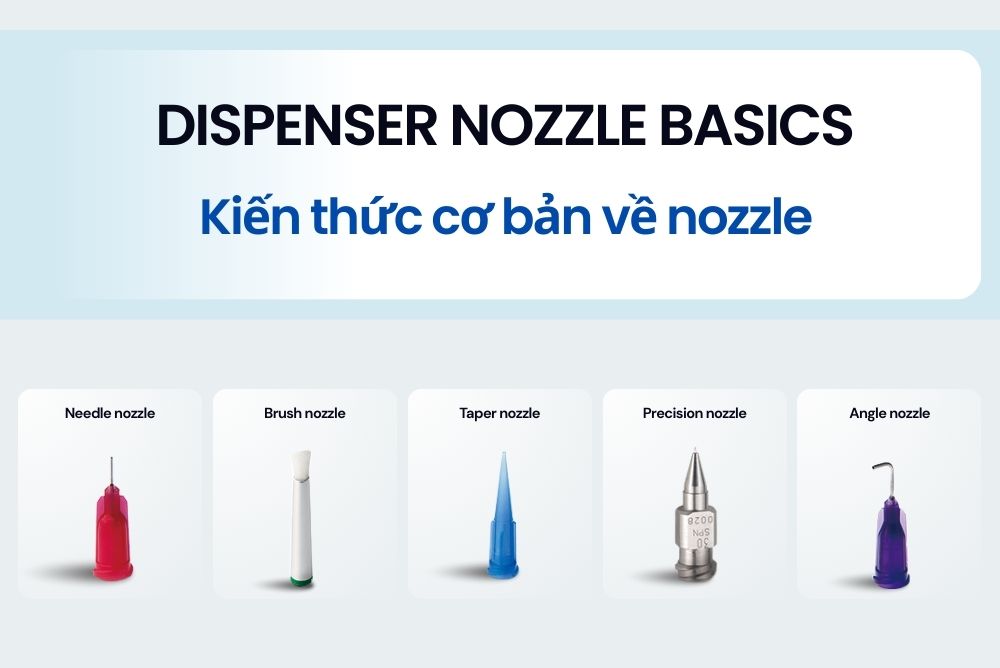
Common Nozzle Types
- Needle nozzle: Suitable for micro-dispensing and narrow areas.
- Taper nozzle: Conical design that reduces air bubble entrapment. Suitable for high-viscosity materials.
- Product: TT Taper nozzle San-ei Tech
- Precision nozzle: High repeatability and accuracy for precision adhesive dispensing.
- Product: Precision nozzle San-ei Tech
- Teflon nozzle: Nozzle made by PTFE (Polytetrafluoroethylene) or TLC (A "Teflon-like" coating, not pure PTFE, typically a polymer or composite coating with properties similar to Teflon). Ideal for fast-curing adhesives and quick-drying solvents that are prone to clogging
- Product: TLC Teflon nozzle San-ei Tech
- Brush / Flat nozzle: Designed for large-area coating with uniform material distribution.
- Product: Brush nozzle San-ei Tech
- Metal nozzle: High durability and versatility for a wide range of applications.
- Product: Metal nozzle San-Ei Tech


Selecting the correct nozzle type reduces defects such as clogging, excess adhesive, and overflow, while improving accuracy, stability, and overall production efficiency.
Common Nozzle Materials
Stainless Steel(SUS)
- High durability and chemical resistance.
- Suitable for corrosive liquids
- Performs well at elevated temperatures
- Commonly used for precision nozzles and needle nozzles.
Plastic (PE, PP)
- Cost-effective.
- Lightweight.
- Used for standard nozzle bodies, tapered needles, or disposable nozzles.
PTFE (Teflon) or TLC (Teflon-Like Coating)
- Non-stick surface
- Excellent chemical resistance
- Ideal for fast-drying adhesives, solvents, and special chemicals

When selecting nozzle materials, carefully evaluate chemical compatibility, cost, cleaning requirements, and replacement frequency.
How to Select the Right Nozzle
Nozzle Selection by Tip Shape
The nozzle tip shape determines the coating pattern:
- Round tips produce circular dots
- Slot or elliptical tips produce wider, linear patterns
Nozzle Selection by Inner Diameter (ID)
| Advantages | Disadvantages | |
| Small ID |
|
|
| Large ID |
|
|
Nozzle Selection by Outer Diameter (OD)
The OD directly affects the final dispensing point size. If a target dot size is predefined, OD should be prioritized during selection.
Nozzle Selection by Application
- Electronics, PCB, small components: Needle nozzles or precision nozzles
- Large-area or high-volume dispensing: Tapered nozzles or wide-mouth nozzles
- Corrosive chemicals or fast-drying materials: PTFE or stainless steel nozzles
- Automated lines with high QC requirements: Precision nozzles or carefully selected ID and nozzle length
When Should a Nozzle Be Replaced?
Nozzles are consumable components. Service life depends on usage frequency and material type:
- Needle nozzles and tapered needles: Typically single-use
- Precision nozzles: Replace when clogging, dripping, tip deformation, or dispensing pattern deviation occurs
- Recommendation: Maintain usage records and establish periodic inspection schedules for critical production lines.
Pre-Dispensing Checklist
- Check the nozzle for clogging or deformation.
- Verify material viscosity and temperature.
- Confirm correct nozzle installation on the dispenser.
- Ensure a clean working environment.
- Perform test dispensing before production.
- Optimize dispenser settings such as speed, pressure, and motion path.
- Keep the nozzle clean during operation to prevent contamination.
Save this article for later?
Fundamental knowledge about nozzles is compiled in this document. Download it for free here.
DOWNLOAD PDF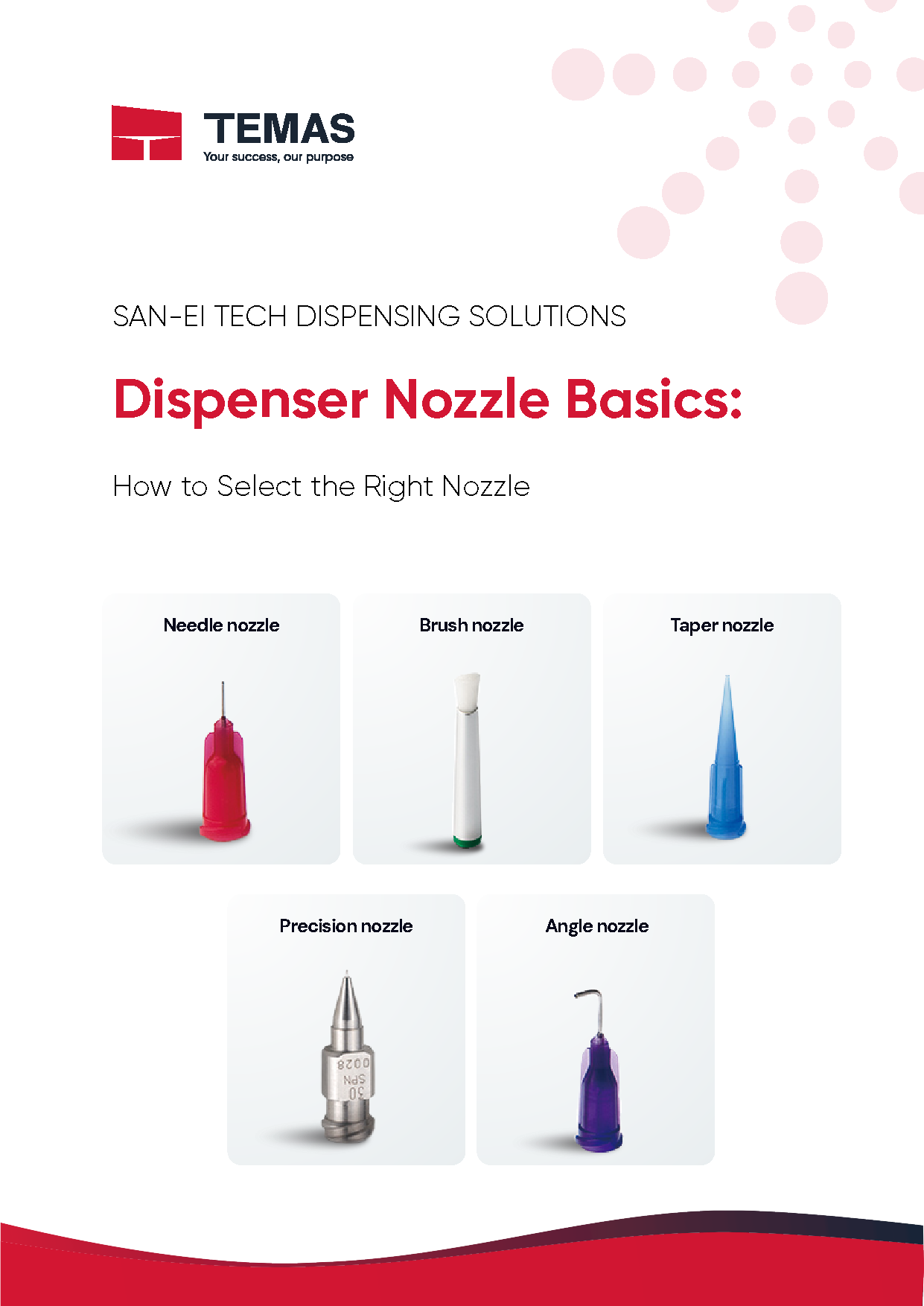
Selecting the right nozzle depends on multiple factors, including material type, solvent characteristics, precision requirements, ID and OD, tip geometry, cost, and maintenance conditions.
Our engineering team is ready to support you with optimized solutions and a wide range of high-quality Japanese nozzles from San-Ei Tech.
Learn more about our dispensing products and solutions here.


 Read more