 Contents
- What Is a SCARA Robot?
- Structure and Operating Principles of SCARA Robots
- How Do the Four Axes Work Together?
- Peripheral Equipment for Industrial Robots
- Where Are SCARA Robots Used?
- Pick-and-Place, Sorting, and Tray Loading
- Assembly, Screwdriving, and Adhesive Dispensing
- Feeding Products into Inspection Stations
- Advantages and Limitations of SCARA Robots Compared with Other Industrial Robots
- The Value of Speed, Repeatability, and Layout
- Selecting a Configuration Based on Product Access Requirements
- How to Select a SCARA Robot Based on Production Requirements
- Payload Includes Both the Product and the Gripper
- Reach and Industrial Robot Layout
- Operating Environment and Long-Term Operation
- Frequently Asked Questions About SCARA Robots
- Can a SCARA Robot Pick and Place Products on a Moving Conveyor?
- Are SCARA Robots Suitable for Multiple Product Variants and Small-Batch Production?
- Discuss SCARA Robot Solutions with Temas
A production line may have high-speed machining equipment but still experience bottlenecks during component picking, rotating, and placement operations. SCARA robots are often considered for handling these repetitive tasks.
Drawing on Temas' experience in the industrial robotics industry, this article explains the structure and applications of SCARA robots, as well as how to evaluate a complete robotic workstation. Clear examples and defined objectives help readers use this information to make choices that align with their operational requirements.
What Is a SCARA Robot?
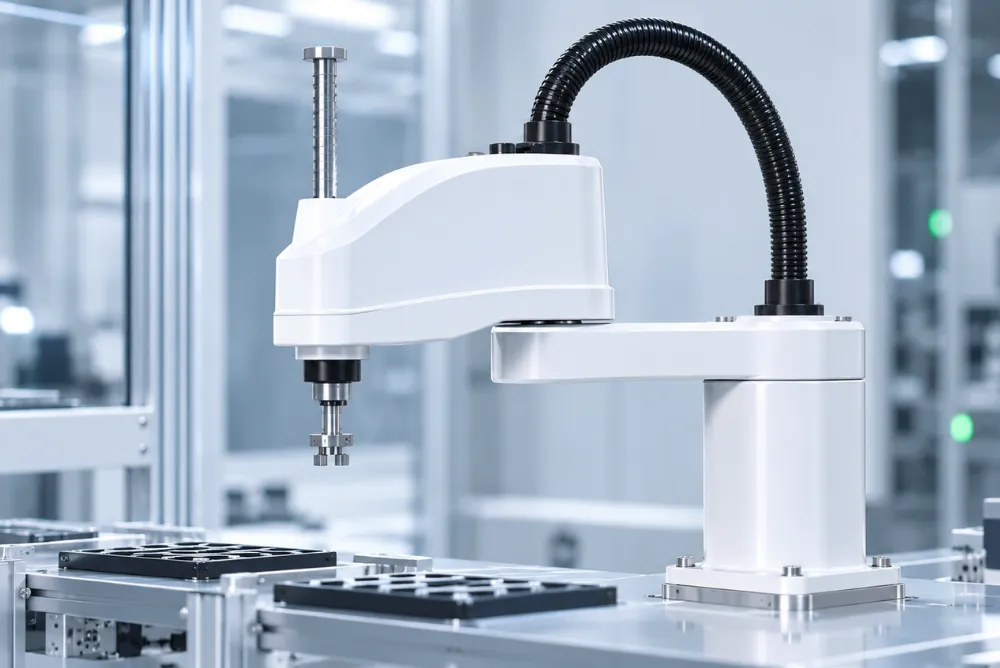
A SCARA Robot (Selective Compliance Assembly Robot Arm) is an industrial robot with a horizontally articulated arm, typically consisting of four axes: two rotary joints that generate X–Y movement, one vertical Z-axis for up-and-down movement, and one axis that rotates the end effector around the Z-axis. This configuration is suitable for pick-and-place, assembly, and top-down access operations.

There are two commonly used interpretations of SCARA in manufacturers' documentation. Oriental Motor uses Selective Compliance Assembly Robot Arm, meaning an assembly robot arm with selective compliance. FANUC uses Articulated instead of Assembly, emphasizing the articulated structure.
"Selective compliance" describes a mechanical characteristic: the robot arm has a certain degree of compliance in the horizontal plane while maintaining rigidity in the vertical direction. This characteristic does not enable a SCARA robot to automatically detect every deviation or correct assembly errors on its own.
Within the industrial robot category, SCARA robots are identified by their motion structure, not by the industries in which they are used. The same type of robot arm can be used for electronics assembly, tray packing, or feeding products into inspection equipment.

Structure and Operating Principles of SCARA Robots
How Do the Four Axes Work Together?
In a four-axis SCARA robot, the first two joints move the end effector to X–Y coordinates. The Z-axis provides vertical movement, while the final axis rotates the component to align its orientation. This coordinated motion differs from that of six-axis industrial robots, which offer greater flexibility in changing tool orientations.

An illustrative cycle: The SCARA robot lowers its suction tool into a tray, picks up a component, moves upward, travels horizontally, and then rotates the component to the correct orientation before placing it. The industrial robot controller coordinates these movements according to the program and workstation signals.
Industrial robot product ranges from some manufacturers also include three-axis SCARA robots alongside the more common four-axis configurations. This difference affects the robot's ability to orient products. Therefore, when selecting a SCARA robot, it is necessary to check the number of axes and the actual movements supported by the model.

Peripheral Equipment for Industrial Robots
SCARA robots operate alongside controllers, grippers, fixtures, and workpiece feeding mechanisms. An industrial robotic workstation also requires coordination signals with upstream and downstream machines, as well as a method for handling defective products.
A camera can be added if product positions or orientations vary. For components that are already correctly positioned in fixtures, the solution may be simpler.
Where Are SCARA Robots Used?
Pick-and-Place, Sorting, and Tray Loading
SCARA robots in pick-and-place applications can transfer components between trays, conveyors, and fixtures within the required working area. With high speed and accuracy, SCARA robots are particularly suitable for pick-and-place applications on electronics and semiconductor production lines.

Assembly, Screwdriving, and Adhesive Dispensing
SCARA robots are suitable for various top-down operations, such as placing gaskets, assembling small components, or positioning a screwdriver at the working location. In industrial robotic screwdriving workstations, the tightening tool and screw-feeding mechanism play an important role in determining quality.
For adhesive dispensing, SCARA robots handle the positioning and movement of end-of-arm equipment, such as dispensing systems that control the amount of adhesive. High-precision movement is an advantage of SCARA robots in this application, making them more suitable than collaborative robots.

Feeding Products into Inspection Stations
SCARA robots can transfer components into measuring equipment and then sort them according to the inspection results. Cameras or measuring devices assess product quality, while industrial robots handle transportation and positioning. Given their specific reach and motion orientation, these factors must be carefully evaluated before installation.
Advantages and Limitations of SCARA Robots Compared with Other Industrial Robots
The Value of Speed, Repeatability, and Layout
SCARA robots focus on pick-and-place and assembly movements that suit their structural configuration. When workpiece feeding, fixtures, and calibration are stable, these robots can accurately repeat programmed operations, helping reduce variation between cycles and improving production line performance. The compact structure of SCARA robots also makes them convenient to position around assembly tables.
Selecting a Configuration Based on Product Access Requirements
One limitation of four-axis SCARA robots is their ability to perform operations at inclined angles. If an application requires working on multiple surfaces, handling inclined planes, or changing tool angles, a six-axis industrial robot may be more suitable.

Among the common types of industrial robots, the following table helps identify a suitable configuration for a given application. This is an application guideline, not a ranking of speed or selling price.
| Criteria | SCARA Robot | Cartesian Robot | Six-Axis Robot |
|---|---|---|---|
| Motion | Horizontal rotary joints, vertical movement, and rotation around the Z-axis | Perpendicular linear axes, with additional rotary axes if required | Coordinated rotary joints that change both position and orientation |
| Suitable Applications | Pick-and-place and top-down assembly | Movement along axes within a box-shaped working area | Accessing multiple surfaces and changing tool angles |
| Key Factors to Consider | Reach, Z-axis stroke, payload, and inertia | Stroke, support structure, and installation space | Orientation, obstacles, and joint limits |
For the same product, gripper, and similar positioning requirements, either a SCARA robot or a Cartesian robot may be used because their operating approaches have certain similarities. To select the right robot for a specific application, it is necessary to understand the differences between SCARA and Cartesian robots.
How to Select a SCARA Robot Based on Production Requirements
Payload Includes Both the Product and the Gripper
The payload carried by a SCARA robot includes the product, gripper, and any attached mounting components. Hypothetical example: If the component weighs 0.8 kg and the gripper and mounting assembly weigh 1.2 kg, the total payload is 2 kg.
A long gripper or an off-center component can generate significant inertia around the rotary axis. At the same angular acceleration, an industrial robot must generate greater torque to accelerate or decelerate a load with higher inertia.
Reach and Industrial Robot Layout
One product line that can be used as an example is the Epson GX4 SCARA robot. For the GX4-A with a 350 mm reach, Epson specifies a rated payload of 2 kg and a maximum payload of 4 kg. The manufacturer also offers reach options of 250 mm and 300 mm. In practical applications, these two payload ratings must be considered separately. The maximum payload should not be interpreted as a guarantee of maintaining every operating cycle.
Operating Environment and Long-Term Operation
SCARA robots used in electronics assembly may require electrostatic discharge (ESD) protection. Cleanroom environments, areas with high levels of dust, or environments exposed to oil require corresponding suitable versions.
For multi-shift operation plans, SCARA robots should have a specific maintenance schedule, a complete spare parts list, and robot program backups in accordance with established procedures to ensure long-term operation.
Frequently Asked Questions About SCARA Robots

Can a SCARA Robot Pick and Place Products on a Moving Conveyor?
Yes, provided that the SCARA robot and control system support conveyor tracking and are properly integrated. Epson SCARA robots can support conveyor tracking, using machine vision or sensors to identify products and coordinate movements.
Are SCARA Robots Suitable for Multiple Product Variants and Small-Batch Production?
They can be suitable if the different product variants share the same picking principles, positioning requirements, and working area. When evaluating a SCARA robot, include changeover time in the shift plan.
If every batch requires fixture replacement, gripper adjustments, and point reteaching, changeover time may outweigh the speed benefits of an industrial robot. In this case, switching to a collaborative robot may be worth considering.
Discuss SCARA Robot Solutions with Temas
SCARA robots are worth considering when operations mainly involve pick-and-place or top-down assembly, and the products and operating cycle have already been defined. Decisions about purchasing industrial robots should be based on the output of the entire workstation, including required production volume, changeover time, and operating costs.
Contact Temas for consultation and support regarding SCARA robots, industrial robots, and other products and factory equipment related to your requirements.



 Read more