 Nội dung
Compressed air is often referred to as the “fourth utility” in industrial facilities, alongside electricity, water, and natural gas. It is widely used and plays a critical role in operating machinery, tools, automation systems, and many manufacturing processes.
However, generating and operating compressed air consumes a significant amount of electrical energy, accounts for a large share of operating costs, and contributes substantially to CO₂ emissions.
So how can factories reduce operating costs and CO₂ emissions while maintaining the productivity benefits of compressed air?
The answer lies in the “4-Bar Factory” concept.

Common Measures to Improve Compressed Air Efficiency
Before explaining what a 4-bar factory is, it is important to understand why this concept was developed.
In many factories, compressed air efficiency is affected by common issues such as pressure drops in the air distribution network, air leakage, insufficient air quality, and inappropriate or wasteful use of compressed air. Typical improvement measures include:
- Eliminating sources of pressure loss in the air supply network
- Improving system isolation by separating zones or branches with shut-off valves, allowing unused areas to be isolated to avoid unnecessary air supply, leakage, and waste
- Preventing inappropriate use of compressed air
- Detecting and fixing air leaks
- Reducing operating pressure
- Ensuring proper compressed air quality
- Recovering energy, especially waste heat generated by air compressors, and reusing it for heating, hot water, or process heating instead of releasing it to the environment
- Improving compressor operating efficiency
The most commonly applied measures are leak management, pressure drop reduction, shutting off compressed air when not in use, system isolation, and ensuring air quality. These actions are relatively quick to implement and do not require high investment.
However, they do not fully solve the problem. New leaks and pressure losses can appear, shutting off air may disrupt machine cycles, and pipelines require frequent maintenance.
A More Fundamental Approach?
All compressed air flows originate from the air compressor. Any demand for compressed air increases the compressor load, and higher system pressure directly leads to higher energy consumption.
When pressure at the point of use is reduced, the volume of air consumed decreases, which in turn reduces the load on the compressor. This leads to a key question: how can overall factory pressure be reduced at the compressor level while maintaining machine performance and system reliability?
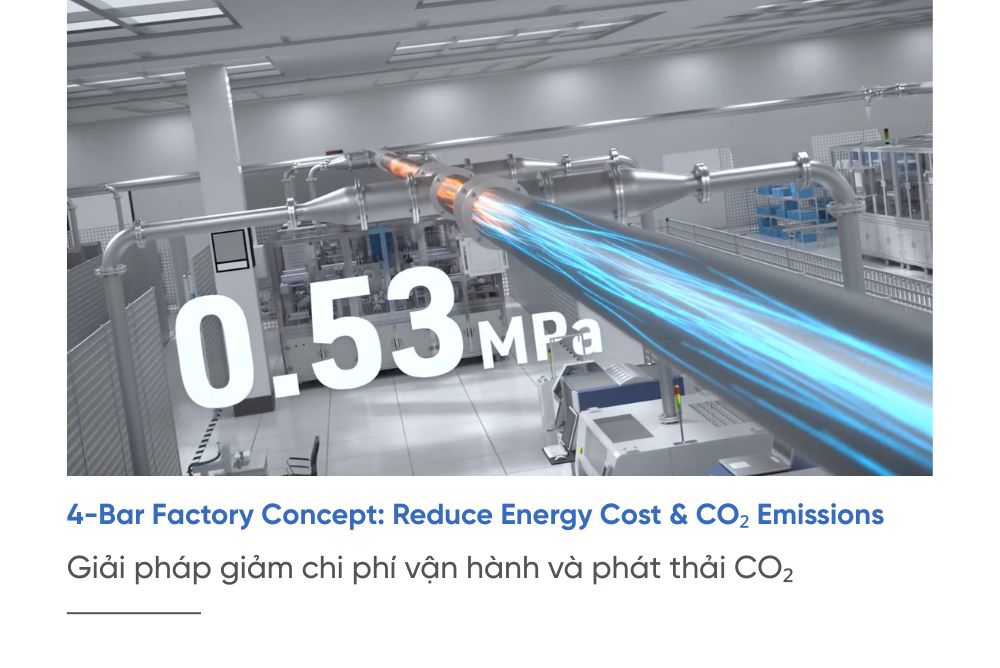
To address this challenge, SMC introduced the “4-Bar Factory” concept. The goal is to significantly reduce energy costs and CO₂ emissions while redefining how compressed air systems are designed and operated.

Compressed air plays a vital role in factory operations
What Is the 4-Bar Factory Concept?
The “4-Bar Factory” refers to a factory model that optimizes its compressed air system by operating at a supply pressure of around 4 bar instead of conventional levels such as 6 to 7 bar or higher.
The objective is to save energy, reduce operating costs, and lower CO₂ emissions while still ensuring reliable equipment performance. This concept was proposed and widely promoted by SMC Corporation, a global leader in pneumatic and automation components.
Implementation Approach
The 4-bar factory concept is typically implemented in stages:
- Energy consumption analysis: Identify inefficient areas and equipment, and determine applications that genuinely require higher pressure.
- Flow and pressure optimization: Reduce supply pressure wherever possible without modifying existing machinery. Only machines that cannot operate at lower pressure are selectively upgraded. Local pressure boosting is applied only where necessary, using components designed for low-pressure operation.
- Future-ready design: Establish standards for new equipment to align with the low-pressure factory model, and integrate products that ensure stable operation even at reduced pressure levels.
In simple terms, the factory transitions from high operating pressure to an optimized level of around 4 bar, while simultaneously maintaining performance and preparing for future requirements.

Benefits of the 4-Bar Factory Concept
Compressed air systems typically account for 20 to 40 percent of a factory’s total electricity consumption.
Many factories operate at higher pressure than actually required, resulting in unnecessary energy waste. On average, reducing supply pressure by 1 bar can lower specific energy consumption by 6 to 8 percent. According to SMC studies, reducing supply pressure from 7 bar to 4 bar can cut energy costs by up to 29 percent while significantly reducing CO₂ emissions.

Compressed air is one of the largest consumers of electrical energy in factory
Lowering compressed air pressure helps to:
- Save energy by reducing compressor load.
- Reduce operating costs
- Reduce CO₂ emissions. SMC estimates that a 1-bar pressure reduction across industry could cut approximately 6,700 kt of CO₂ emissions in Europe alone.
- Reduce compressed air consumption
- Minimize leakage losses
- Extend component service life
- Reduce maintenance requirements
- Improve overall safety

Practical Steps to Implement the 4-Bar Factory Model
Step 1: Analyze Actual Compressed Air Usage
- Review the compressor supply profile.
- Visualize pressure and flow of operating equipment.
- Verify the required supply pressure for each machine.
- Identify which areas consume the most compressed air and at what times.
- Measure air demand during idle or standby conditions.
- Identify high air-consuming equipment for dedicated supply solutions.
- Prioritize inefficient areas and equipment with high optimization potential.

Step 2: Stabilize Flow and Pressure
- Reduce pressure locally at each production area.
- Use double force cylinders, pressure boosters, or locally controlled air reservoirs at machines that require higher pressure.
- Did you know? SMC offers high-efficiency pressure boosters capable of locally increasing pressure up to four times the original supply pressure.

- Replace selected components with low-pressure-optimized alternatives that maintain performance, such as high-efficiency air nozzles and high-efficiency vacuum units.
- Implement measures to prevent air loss during standby and reduce leakage losses.
- Optimize compressed air piping and blow-off systems.
- Re-evaluate machine performance after pressure reduction to confirm energy savings while maintaining output.
- Reduce overall factory supply pressure only after confirming that machines operate optimally at reduced local pressure. If targets are not met, apply additional measures before lowering plant-wide pressure.
You can also watch the following SMC video for a visual explanation of this solution.
Step 3: Establish the 4-Bar Factory Standard
- Align objectives among the factory, machine builders, and SMC.
- Select the most suitable technologies, balancing pneumatic, vacuum, and electric actuation solutions.
- Integrate components seamlessly with existing machinery.
- Validate that performance and productivity targets are met.
- Design for the future by selecting and specifying machinery according to the new standard.
- Did you know? New SMC products are developed with future low-pressure trends in mind.


Temas engineers are ready to support you throughout the evaluation and implementation of the 4-bar factory solution with a focus on speed, cost efficiency, and proven results.
See more: SMC products.
Key Concerns Engineers Have When Reducing Supply Pressure
Reducing compressed air pressure requires changes to long-established standards and operating practices. Common concerns raised by engineers include system reliability, machine performance, and implementation complexity:
| Concerns | Proposed Solutions |
| Machines will run slower | We will review the efficiency of the existing compressed air supply system and implement targeted improvements without negatively affecting production performance. |
| The factory has always operated at high pressure (6–7 bar) | We will measure and analyze actual air consumption and all existing equipment to determine the most appropriate pressure reduction. The system will not be reduced to 4 bar immediately, but adjusted step by step to an optimal level. |
| Existing machines cannot operate at lower supply pressure | Each machine will be evaluated individually. Suitable measures will be applied, such as replacing components that can operate at lower pressure or using pressure boosters for machines that require higher pressure. |
| High pressure may be necessary at certain times |
Supply pressure is often set too high due to legacy settings, upstream pressure drops that require compensation, or fluctuating and unstable air demand. These issues can be addressed. Continuous high pressure causes waste of compressed air and electricity and increases stress on compressors and machinery. Dedicated solutions will be implemented for machines that genuinely require higher pressure, such as local pressure boosters or localized control systems. |
| Equipment suppliers design machines for higher pressure | We will work closely with you and your machine suppliers to ensure stable operation at lower pressure. We also support the development of new design standards so future equipment is ready for the 4-bar factory model. |
| Such changes require time, effort, and cost | We will define the most optimized transition plans. Existing machinery does not need to be replaced. Only compressed air-related parameters are adjusted to meet the new operating model. |
We understand this transformation cannot be completed overnight. Our engineers are ready to support you at every stage of the journey.
Reduce energy costs and CO₂ emissions with the 4-Bar Factory Concept
This PDF provides a 4-Bar Factory roadmap, including real energy-saving data and case studies, to help you assess feasibility before implementation.
DOWNLOAD PDF
Case Study: The 4-Bar Factory in Practice
SMC has led this trend by implementing the 4-bar factory model in its own manufacturing facilities.
The SMC Shimotsuma in Japan consists of two factories with a total floor area of 72,167 m². This is one of SMC’s long-established production sites.
SMC implemented a phased pressure reduction for the two-story Building 1 of Factory 1. The results are as follows:
| Building 1 – Before Implementation | Building 1 – After Implementation |
|
|
These results indicate that applying this approach across the entire factory can significantly reduce energy costs and CO2 emissions. It also helps manufacturers move closer to Net Zero targets, support sustainable production, and strengthen overall competitiveness.
Temas is an authorized distributor of SMC in Vietnam. With experienced engineers trained directly by SMC, Temas supports customers in evaluating, selecting, and implementing compressed air solutions, including the 4-bar factory concept.
Contact us today to optimize your factory’s compressed air system.



 Read more