.jpg)
 Content
Desktop robots are compact industrial automation systems typically designed around a Cartesian coordinate structure with three or four axes of motion: X, Y, Z, and an optional rotational R axis. These axes are driven by stepper motors to move either the tool or the workpiece across a fixed working platform.

How a Desktop Robot Is Structured and How It Works
In a typical configuration:
- The workpiece is mounted on the X-table.
- The X-axis moves the table forward and backward.
- The tool unit travels left and right along the Y-axis.
- Vertical positioning is controlled by the Z-axis
- Each axis is commonly powered by a stepper motor with encoder feedback for accurate positioning and step-out detection.

Desktop robots operate through linear motion along independent axes. Instead of complex articulated movements, each axis moves in a straight line according to programmed coordinates.
Payload Capacity and Working Range
Janome desktop robots are available in five different sizes, enabling users to select the most suitable model according to application requirements and workpiece dimension.
| Operating Range [mm] | Maximum Portable Load [kg] | ||||
|---|---|---|---|---|---|
| X | Y | Z | R * | Workpiece | Tool |
| 200 | 200 | 50 | ±360° | 7 | 3.5 |
| 300 | 320 | 100 | 15 | 7 | |
| 400 | 400 | 150 | |||
| 510 | 510 | ||||
| 510 | 620 | ||||
Desktop robots require the workpiece itself to be fixed onto the X table and moved during operation.
As shown in the table above, it is important to note that the standard model does not support workpieces exceeding 15 kg in mass. The JR3000 series with a Heavy-Duty specification can handle workpieces up to 20kg.
Due to these characteristics, desktop robots are generally well-suited for standalone cell production, where each unit operates independently.
In recent years, however, desktop robots have been integrated into more complex production systems, including:
- Integration with collaborative robots
- Arranged in parallel configurations
- Customized into systems that work in sync with conveyors
Real-World Manufacturing Applications
Desktop robots excel at ultra-precise operations on small components.
Watch video: JANOME Automated Assembly Line
Typical examples include micro dispensing tasks such as fine sealing and adhesive application.
Other common applications of desktop robots include the following processes:
- Screw tightening
- Soldering with soldering iron or laser soldering
- PCB depaneling (router cutting method)
- Visual inspection using image processing
- Press-fitting of pins
- Surface treatment using atmospheric pressure plasma
Many of these processes differ significantly from traditional pick-and-place applications. However, desktop robots are still used for:
- Picking small components such as screws or pins from pallets
- Performing precise assembly onto workpieces
Overview – Fundamental Knowledge of Janome Desktop Robots
The Basic Structure of Desktop Robots, 5 Key Criteria for Selecting a Desktop Robot, and a Comparison Between Desktop Robots and Articulated Robots – All in One Document!
DOWNLOAD PDF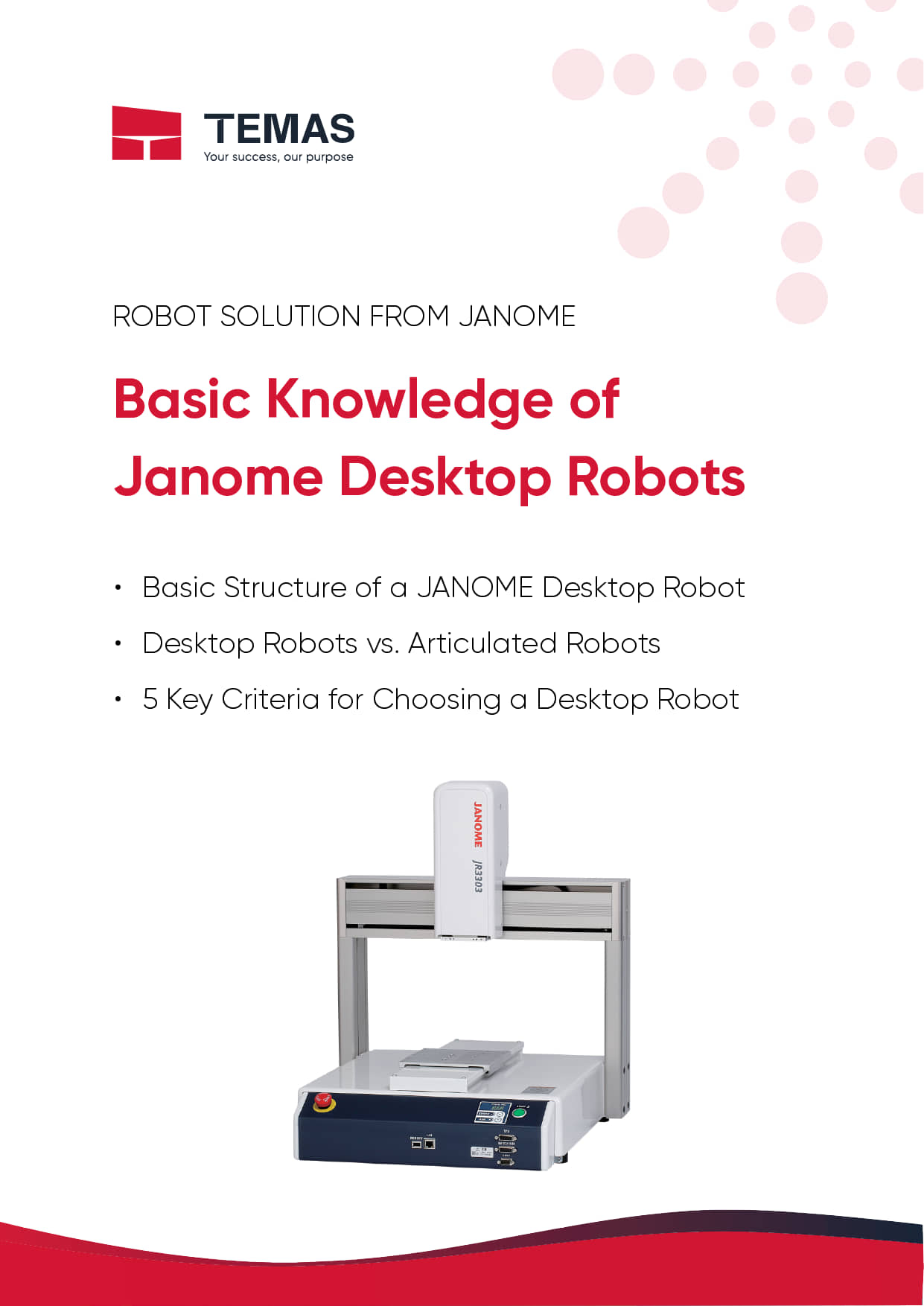
Case study: Desktop Robot Integration for Automated Screw Fastening
JR3000 Series Screw Fastening & Loosening
Case study: Desktop Robot Integration for Automated Dispensing Applications
Dispensing Operation Using a 4-Axis Robot with an Additional Rotational Axis Mounted on the Tool
Desktop robots provide an optimal solution for repetitive and high-precision manufacturing tasks in automated factories. Selecting the appropriate size, payload capacity, encoder configuration, and control interface is critical to ensuring application efficiency and long-term stability.
For further guidance, explore the five key criteria for selecting a desktop robot or contact us for fast, accurate consultation on the model best suited to your application.



 Read more