 Nội dung
- What Is a Chiller?
- Why Temperature Control Is Essential in Manufacturing?
- How a Chiller Works
- SMC Chillers with High Precision and Optimized Performance
- Common SMC Chiller Types
- Industrial Applications of Chillers
- Key Parameters When Selecting a Chiller
- Auxiliary Components to Optimize Chiller Performance
In industrial systems, temperature control plays a vital role in ensuring stable equipment operation, consistent product quality, and uninterrupted production. One of the most essential devices for this purpose is the chiller, also known as a temperature control unit.
This article provides a clear and practical overview of what a chiller is, how it works, why temperature control is critical in manufacturing, and how SMC chillers are widely applied across modern industrial sectors.

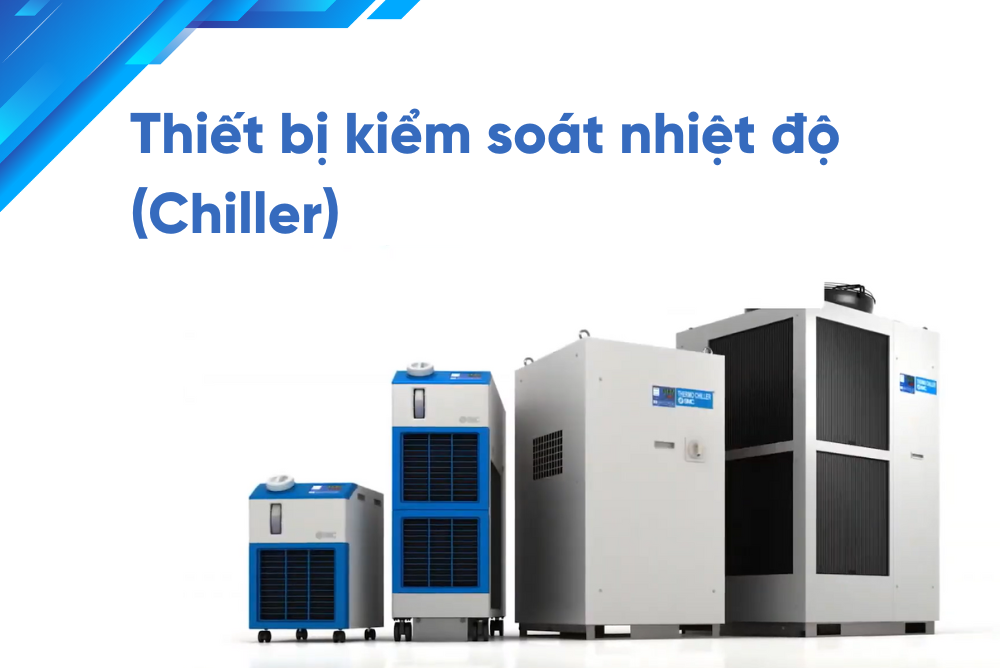
Chiller - Temperature Control Device
What Is a Chiller?
A chiller is a device used to control the temperature of circulating water or other process fluids in order to regulate or maintain a stable temperature for industrial equipment and manufacturing processes.

In factories, chillers are commonly used to:
- Cool heat-generating equipment
- Stabilize mold temperature
- Maintain equipment or process temperatures at optimal levels
- Prevent equipment damage caused by overheating
Maintaining stable temperatures helps extend equipment lifespan, reduce product defects, and improve overall production efficiency.
Why Temperature Control Is Essential in Manufacturing?
Preventing Equipment Damage
Many industrial machines operate at high temperatures, such as:
- Metal welding systems
- Laser processing equipment
- Mold heating systems
Without proper cooling, prolonged exposure to heat can lead to premature equipment failure. Chillers supply circulating cooling water to stabilize temperatures and protect critical components, significantly extending service life.

Chillers are widely used in welding applications for this reason.
Ensuring Consistent Product Quality
Many manufacturing processes require precise temperature control to maintain product quality. In plastic injection molding, for example, fluctuations in mold temperature can cause:
- Product deformation
- Dimensional inaccuracies
- Increased defect rates

Overheated molds often result in warped or inconsistent molded parts.
By cooling metal molds and maintaining a stable mold temperature, chillers ensure uniform product quality and reliable production outcomes.
Preventing Material Property Changes
Some materials experience structural changes when exposed to large temperature variations. A typical example is grinding equipment, where chillers are used to cool the machine housing. Precise temperature control helps preserve material properties throughout the machining process.

Using Chiller for Grinding equipment
How a Chiller Works
Consider a simple example of using a chiller to cool a welding torch.
Cooling water flows through the welding torch and absorbs heat. The heated water is then sent to a cooling section, where its temperature is reduced before returning to a storage tank. The cooled water is pumped back to the torch, forming a closed-loop circulation system. All of these functions are integrated into a single unit known as a chiller.

In simple terms, a chiller operates as a closed-loop cooling system:
- The cooling fluid absorbs heat from the equipment
- The heated fluid returns to the chiller
- Inside the chiller, the fluid is cooled through a heat exchanger
- The cooled fluid is recirculated back to the equipment
To visualize this, imagine trying to cool a hot kettle:
- Placing it in a bucket of cold water quickly heats the water, making further cooling ineffective
- Continuously replacing the water wastes resources
- Using ice requires constant replenishment and is inefficient

A chiller eliminates these issues. The circulating fluid passes through a heat exchanger, where heat is transferred and removed by the refrigeration circuit. The fluid is continuously cooled inside the system and reused without loss or replacement. This results in an efficient, stable, and energy-saving cooling solution.
SMC Chillers with High Precision and Optimized Performance
SMC chillers offer high-precision temperature control with accuracy up to ±0.1°C. By circulating fluid at a precisely controlled temperature, they function not only as cooling units but also as temperature regulation devices that maintain constant process temperatures
SMC chillers also support remote monitoring and control. With built-in RS-232C and RS-485 serial communication and I/O connectivity, users can read and write data, perform self-diagnostics, and monitor key process variables such as pressure, flow rate, and temperature.
These features make SMC chillers suitable for applications requiring extremely high stability, including:
- Laser
- Analytical instruments
- CNC machines
- Plastic injection molding machines
- LCD production lines
- Optical equipment
SMC offers multiple chiller series designed to meet different operating environments and application requirements
Common SMC Chiller Types
SMC chillers are categorized into five main types: standard type, rack mount type, inverter type, dual-channel type, and environmentally resistant type
1. Standard Type
- Compact design that saves installation space (Smallest the HSRE series: HRS012/ HRS018/ HRS024)
- Automatic restart after power failure
- Low fluid level protection
- Built-in timer function
- Most commonly uses refrigerant gas (Operating temperature range from 5°C to 40°C)
Typical applications include laser machining, plastic mold manufacturing, analytical instruments, and LCD production equipment.

2. Rack Mount Type
- Compact size suitable for installation in 19-inch racks
- Allows maintenance without removing the unit from the rack
- Uses Peltier thermoelectric cooling technology
- Quiet operation with no moving parts or compressors

3. Inverter Type for Energy Saving
- Equipped with inverter control technology
- Reduces power consumption by up to 53 percent
- Cooling capacity:
- Air-cooled: 9.5 kW
- Water-cooled: 11 kW
- Temperature setting range from 5°C to 40 °C
- Stable operation with temperature accuracy of ±0.1°C.
This is an ideal solution for factories focused on energy efficiency and optimized operation.

4. Dual-Channel Chiller
- Simultaneously controls two different temperatures using separate fluid circuits
- Designed specifically for laser processing machines
- Reduces power consumption by approximately 30 percent

5. Environmentally Resistant Type
- Designed for dusty, humid, or splash-prone environments
- Easy to maintain
- Durable and stable under harsh operating conditions

Industrial Applications of Chillers
Chillers are widely used in many industries, including:
- Electronics and semiconductor manufacturing: cooling UV lamps in drying equipment, maintaining chamber temperatures during etching and sputtering processes
- LCD production lines: temperature control for surface treatment solutions and exposure systems
- Laser equipment: cooling irradiation components and laser-affected zones
- Welding systems: cooling welding torches and power supplies in arc welding machines
- Industrial printing: cooling ink rollers and UV lamps
- Plastic injection molding: cooling molds
- Optical equipment: stabilizing optical blocks, cooling image sensors and industrial cameras, controlling lens and illumination module temperatures
- Renewable energy systems
- Medical and laboratory applications: temperature control of electron beams in electron microscopes


- Heavy industry: cooling and stabilizing temperatures during bulk material processing such as grinding
- Water treatment processes
- Cryogenic cooling equipment
- Automated assembly lines

Thanks to their precise and flexible cooling capabilities, chillers help maintain productivity, reduce product defects, and protect valuable equipment
Key Parameters When Selecting a Chiller
Selecting the right chiller is critical to ensuring stable operation, sufficient cooling capacity, and optimized operating costs. The following parameters should be carefully evaluated by engineers:
Cooling capacity
Cooling capacity reflects the chiller’s ability to absorb heat. It must be sufficient to offset the heat generated by equipment such as lasers, molds, welding power supplies, and UV systems
If the capacity is too low, the chiller will operate continuously, leading to overload and reduced lifespan. Oversized units waste energy. It is recommended to select a cooling capacity at least 120 percent of the actual heat load to allow operational margin.
Flow Rate and Pump Head
Flow rate determines how quickly the cooling fluid circulates through the equipment and returns to the chiller.
Flow rate and pump head must match:
- Piping length
- Pressure losses through fittings
- Minimum flow requirements of equipment such as lasers, welding systems, and CNC machines
Insufficient flow reduces heat transfer efficiency, while inadequate pump head can cause unstable flow and cavitation.
Temperature stability
Higher temperature stability results in more consistent equipment performance and product quality. This parameter is critical for high-precision applications.
SMC chillers provide temperature control accuracy of ±0.1°C, meeting stringent thermal stability requirement.
Cooling Method and Circulating Fluid
The cooling mechanism determines heat exchange efficiency. Depending on the model, SMC chillers use either refrigerant-based cooling or Peltier thermoelectric modules.
Refrigerant systems are suitable for higher capacities, while Peltier systems are ideal for low-noise, low-vibration environments without compressors.
Depending on operating conditions, the circulating fluid can be tap water or water mixed with approximately 15 percent glycol for freeze protection and corrosion resistance.
Communication Interfaces
In factories aligned with automation and Industry 4.0 principles, remote monitoring and data integration are essential.
SMC chillers support RS-232C and RS-485 communication, enabling:
- Data reading and writing
- Operational monitoring
- I/O integration
- Self-diagnostic functions
Engineers can monitor pressure, flow rate, and temperature in real time and integrate chiller data into factory management systems.
Auxiliary Components to Optimize Chiller Performance
To maximize the performance of SMC chillers, the use of auxiliary components is recommended, including:
- Fittings
- Tubing
- Industrial filters
- Pressure sensors
- Flow sensors
These components help ensure stable operation and consistent fluid quality. Temas supplies complete SMC chiller systems along with all necessary accessories, providing customers with reliable and integrated solutions.
Save this article for later?
Fundamental knowledge about chillers, including definitions, operating principles, and applications, is compiled in this document. Download it for free here.
DOWNLOAD PDF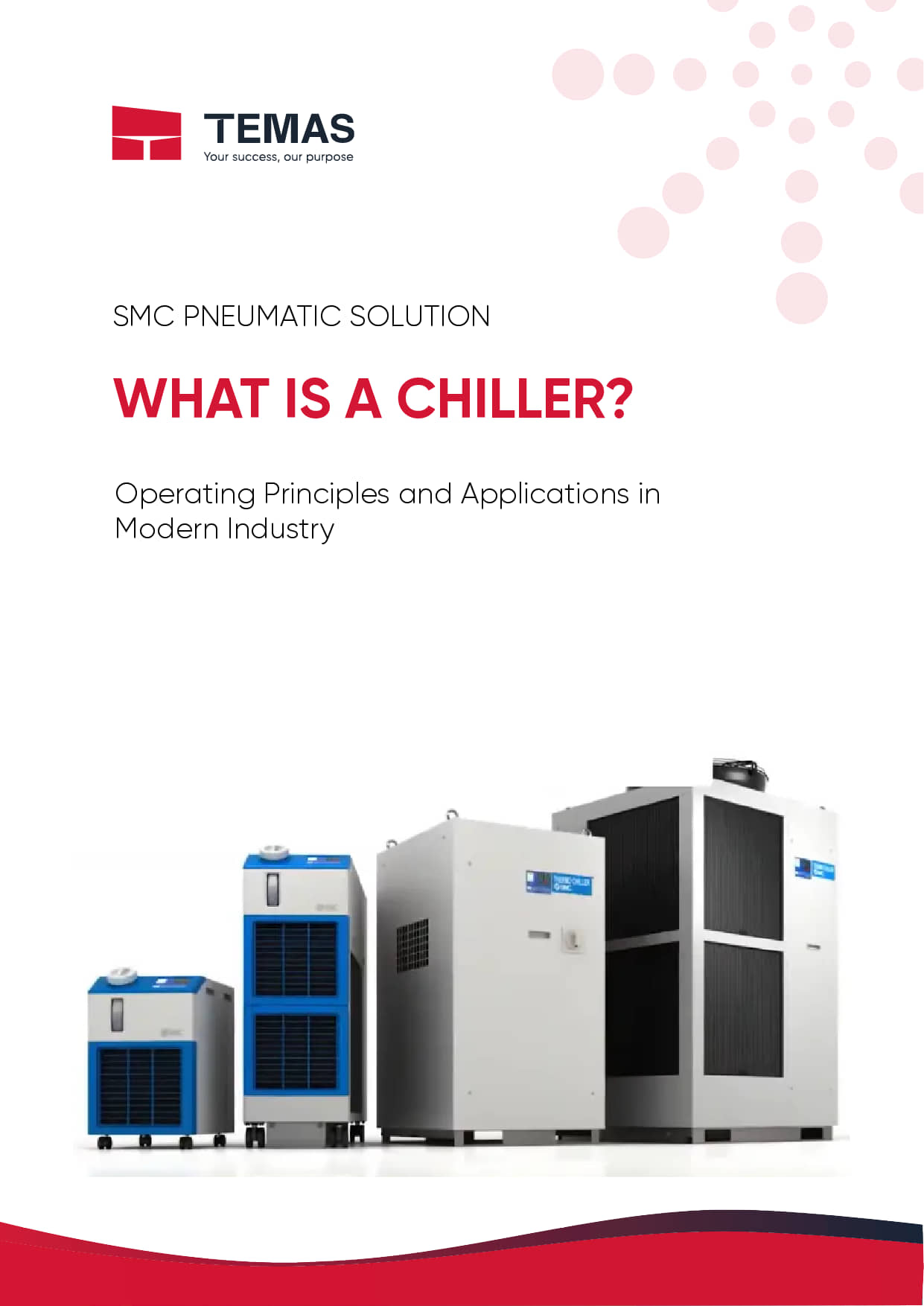
Chillers are a critical solution in modern production lines, enabling stable temperature control, equipment protection, reduced product defects, and optimized factory performance. With a diverse product lineup, SMC chillers offer flexible solutions for a wide range of industrial applications
Temas is an authorized distributor of SMC in Vietnam. Contact us for professional consultation and to select the most suitable chiller solution for your application.



 Read more