 Contents
- 1. What Is a Cartesian Robot?
- 2. Construction and Operating Principles of Cartesian Robots
- 2.1. Construction of a Cartesian Robot
- 2.2. How a Cartesian Robot Works
- 3. Types of Cartesian Robots
- 3.1. Classification by Number of Axes
- 3.2. Classification by Frame Design
- 3.3. Classification by Drive Mechanism
- 4. Advantages and Limitations of Cartesian Robots
- 4.1. Advantages of Cartesian Robots
- 4.2. Limitations of Cartesian Robots
- 5. Applications of Cartesian Robots in Manufacturing
- 5.1. Automated Adhesive Dispensing
- 5.2. Screwdriving and Component Assembly
- 5.3. Automated Pick-and-Place and Workpiece Feeding
- 5.4. Product Inspection and Measurement
- 5.5. Product Packaging and Sorting
- 6. Comparing Cartesian, SCARA, and 6-Axis Robots
- 7. How to Select a Cartesian Robot for a Factory
- 7.1. Axis Travel and Number of Axes
- 7.2. Payload
- 7.3. Accuracy and Repeatability
- 7.4. Speed and Cycle Time
- 7.5. Integration Capability and Investment Costs
- 8. Janome JC-3 Series Cartesian Robots at Temas
- 8.1. Key Features of the Janome JC-3 Series
- 8.2. Specifications of Selected Janome JC-3 Models
- 8.3. Janome JC-3 Applications in Manufacturing
- 9. Frequently Asked Questions About Cartesian Robots
- How Does a Cartesian Robot Differ from a Gantry Robot?
- Can a Cartesian Robot Follow a Curved Path?
- When Should You Choose a Cartesian Robot Over a SCARA Robot?
- 10. Cartesian Robot Consultation at Temas
Cartesian robots are a class of industrial robots used in many automated manufacturing operations such as adhesive dispensing, screwdriving, component pick-and-place, and product inspection. Their motion along perpendicular coordinate axes allows them to meet a range of requirements for positioning, repeatability, and working range.
What is a Cartesian robot, what types are available, and which manufacturing operations are they suited to? Temas explores these questions below.

1. What Is a Cartesian Robot?
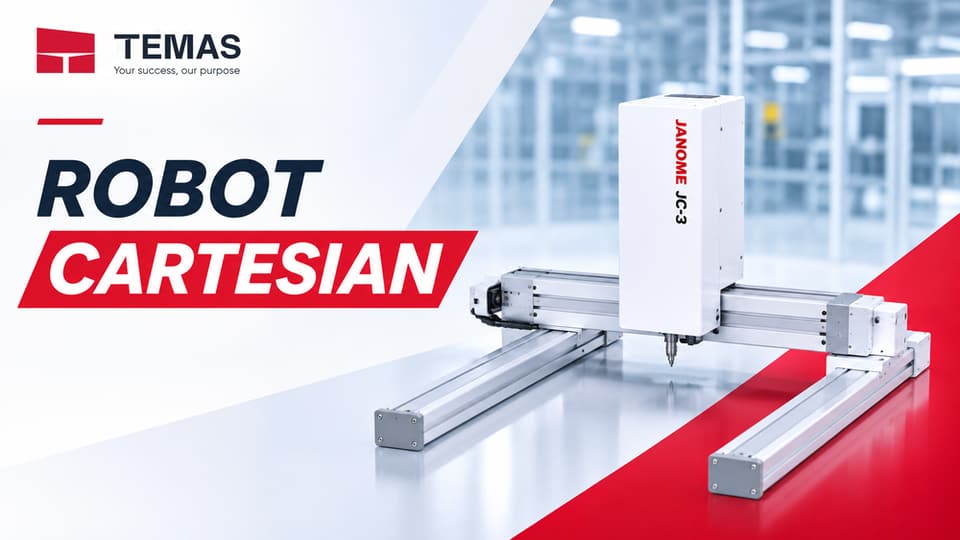
A Cartesian robot, also called a Cartesian coordinate robot, uses mutually perpendicular linear axes, typically designated X, Y, and Z.
SCARA and articulated robots use rotary joints, whereas a Cartesian robot moves its end effector by coordinating its linear axes. Some configurations include an additional rotary axis, R, to change the orientation of the tool or workpiece.
A 3-axis Cartesian robot typically has a rectangular work envelope whose dimensions depend on the travel of each axis.
Depending on the application, the robot can be fitted with a gripper, adhesive dispensing needle, screwdriving head, industrial camera, or measurement and inspection equipment.
2. Construction and Operating Principles of Cartesian Robots
2.1. Construction of a Cartesian Robot
A Cartesian robot typically includes the following main components:
- Support frame. Connects the axis assemblies and provides rigidity and stability during operation.
- Linear axis assemblies. Produce motion along the X, Y, and Z axes.
- Guide mechanisms. Guide the moving components and keep them stable during travel.
- Drive mechanisms. May use ball screws, timing belts, or other linear drive arrangements.
- Motors. Drive the axes. Servo motors and stepper motors are commonly used.
- Controller. Processes the program, controls position and speed, and coordinates motion between axes.
- End effector. Performs tasks such as pick-and-place, adhesive dispensing, screwdriving, or product inspection.
The system can also integrate PLCs, sensors, cameras, and feeding equipment according to production line requirements.

2.2. How a Cartesian Robot Works
A Cartesian robot operates in a Cartesian coordinate system. The controller receives the program and directs the axes to move to the required position.
In a typical installation:
- X axis. Moves horizontally in one direction.
- Y axis. Moves horizontally, perpendicular to the X axis.
- Z axis. Moves up and down.
- R axis. Provides rotary motion if the robot is equipped with an additional rotary axis.
The axes can move individually or in coordination to produce the required end effector path.
In addition to point-to-point (PTP) motion, a Cartesian robot can execute continuous-path (CP) motion along straight lines, curves, and circular arcs if the controller supports the corresponding interpolation.
Path control is particularly important in adhesive dispensing and coating applications.

3. Types of Cartesian Robots
Cartesian robots can be classified by number of axes, frame design, and drive mechanism.
3.1. Classification by Number of Axes
2-Axis Cartesian Robots
These robots use two linear axes, typically XY or XZ, to move in a plane.
This configuration is suitable for positioning, transferring components, or moving tools when motion in all three directions is unnecessary.
3-Axis Cartesian Robots
These robots use the X, Y, and Z axes to position the end effector in three-dimensional space. This configuration is common in adhesive dispensing, screwdriving, pick-and-place, and product inspection.

4-Axis Cartesian Robots
In addition to the three linear axes X, Y, and Z, these robots have a rotary R axis that changes the orientation of the end effector or workpiece.
This configuration is suitable for assembly, pick-and-place, and component handling operations that require the angle of rotation to be adjusted.
3.2. Classification by Frame Design
Cantilever Cartesian Robots
In a cantilever design, an axis extends from one side of the support frame. This leaves the workspace accessible and makes it easier to position fixtures and peripheral equipment.
The design must account for the payload, the length of the overhang, and structural deflection.
Gantry Cartesian Robots
A gantry robot uses a frame supported on both sides. Axis assemblies mounted on the frame provide motion within a defined workspace.
This design suits applications that require a large workspace, long travel, or high rigidity. Examples include feeding workpieces, transferring products, and dispensing adhesive on large parts.
A gantry is one frame design used in Cartesian systems. Cartesian robots can also use other frame designs.
3.3. Classification by Drive Mechanism
| Drive mechanism | Characteristics | Suitable applications |
|---|---|---|
| Ball screw | High drive stiffness and good positioning capability | Assembly, screwdriving, precision positioning |
| Timing belt | Suitable for many long-travel, high-speed configurations | Pick-and-place, workpiece transfer, packaging |
| Linear motor | Produces linear motion directly, without a mechanism to convert rotary motion into linear motion | Applications requiring high speed, high acceleration, and a high degree of motion control |
| Rack and pinion | Can be used in long-travel systems | Gantry robots and systems for transferring large products |
Drive selection depends on the system’s payload, travel, speed, and accuracy requirements, as well as its investment cost.

4. Advantages and Limitations of Cartesian Robots
4.1. Advantages of Cartesian Robots
Good positioning capability and repeatability
The linear axis arrangement suits many operations that require consistent positioning, particularly adhesive dispensing, screwdriving, and component assembly.
Straightforward coordinate programming
Working positions are defined along the X, Y, and Z axes, making it easy to set up the program and adjust working positions on the product.
Choice of axis travel
Manufacturers can select the travel of each axis to suit the product dimensions, fixture dimensions, and required working range.
A range of integration options
Cartesian robots can be combined with grippers, screw feeders, adhesive dispensing systems, industrial cameras, and other automation equipment.
Ease of maintenance
In a suitably designed system, separate axis assemblies can make components easier to inspect, service, and replace.
4.2. Limitations of Cartesian Robots
- Cartesian robots have less freedom to change end effector orientation than 6-axis articulated robots.
- Long travel requirements can significantly increase the size of the support frame.
- Stiffness, deflection, and load must be calculated for each axis.
- Cartesian robots are unsuitable for some operations that require access to a product from multiple complex angles.
- Changing the workspace may require modifications to the mechanical structure.
Cartesian robots are effective in operations with defined working positions and little need to change the orientation of the end effector.
5. Applications of Cartesian Robots in Manufacturing
5.1. Automated Adhesive Dispensing
Cartesian robots guide a dispensing needle to programmed points or along a programmed path on a product.
Common applications include:
- Dispensing adhesive on printed circuit boards (PCBs).
- Applying adhesive to seal equipment housings.
- Injecting adhesive into components.
- Applying coatings along defined paths or over specified areas.
- Dispensing adhesive in the manufacture of automotive components and electronic equipment.
In an automated dispensing system, the robot positions and moves the needle, while the adhesive supply equipment controls the amount of material delivered. The relationship between travel speed and adhesive flow rate directly affects bead quality.

5.2. Screwdriving and Component Assembly
A Cartesian robot can work with an automatic screw feeder and a screwdriving tool to perform a programmed assembly operation.
The robot moves the screwdriving head to each screw location on the product. The tool then tightens the screw according to the specified process parameters.
This application is common in the manufacture of circuit boards, electronic equipment, household appliances, and plastic components.
Joint quality depends on the stability of the positioning system, the fixture, and the screwdriving tool, as well as the ability to control tightening torque.
5.3. Automated Pick-and-Place and Workpiece Feeding
When fitted with a suitable gripper, a Cartesian robot can perform pick-and-place operations such as:
- Moving components from a tray to a fixture.
- Feeding workpieces into an automated machine.
- Transferring products between operations.
- Arranging components in specified positions.
The linear axis arrangement suits systems with consistent pickup and placement locations.
5.4. Product Inspection and Measurement
A Cartesian robot can move an industrial camera, sensor, or measuring probe to the required inspection positions.
With suitable measurement and inspection equipment, the system can perform visual inspections, check for the presence of components, measure dimensions, or detect product defects.
5.5. Product Packaging and Sorting
Cartesian robots can be used for the following operations:
- Placing products in trays or boxes.
- Sorting products by position.
- Transferring products between conveyors.
- Stacking goods according to a program.
Applications involving the packaging and handling of large items require a configuration with the payload, travel, and speed to meet production requirements.
6. Comparing Cartesian, SCARA, and 6-Axis Robots
Each robot type has distinct motion characteristics and a different range of applications.
| Criterion | Cartesian robot | SCARA robot | 6-axis articulated robot |
|---|---|---|---|
| Structure | Mutually perpendicular linear axes | Rotary joints combined with a vertical axis | A series of connected rotary joints |
| Typical number of axes | 2–4 axes | 4 axes | 6 axes |
| Workspace | Defined by the travel of each axis | Defined by reach and joint limits | Three-dimensional space |
| Approach direction | Along the installed axes | Primarily from above | Flexible approach from multiple directions |
| Strengths | Positioning and movement to specified coordinates | High-speed pick-and-place and assembly | Changing tool position and orientation |
| Applications | Adhesive dispensing, screwdriving, workpiece transfer | Pick-and-place, component assembly | Workpiece feeding, welding, surface treatment |
Cartesian robots suit operations with a defined workspace and a relatively consistent direction of approach. SCARA robots have an advantage in many high-speed pick-and-place applications, while 6-axis robots suit tasks that require access to a product from multiple directions.
Selection should be based on the specifications of each model and the actual requirements of the operation.
7. How to Select a Cartesian Robot for a Factory
7.1. Axis Travel and Number of Axes
The robot’s travel must accommodate the product dimensions, working positions, fixture height, and clearance required for the end effector.
A 2-axis robot may be sufficient if the operation requires motion only in a plane. A 3-axis robot can be selected for operations that require the tool to be raised or lowered. A rotary R axis is added when the angle of the end effector or product needs to change.
7.2. Payload
The required payload must be determined from the total mass each axis carries, including:
- The gripper or tool.
- The product being moved.
- Mounting hardware and accessories attached to the moving structure.
- Any axis assemblies supported by the axis in question.
In a robot with stacked axes, the load on one axis can include the mass of other moving assemblies. Manufacturers should check the payload limits of each model before making a selection.
7.3. Accuracy and Repeatability
These are two distinct specifications to consider when selecting a robot:
- Accuracy indicates how closely the actual position matches the target position.
- Repeatability indicates the ability to return to the same position over repeated operations.
Good repeatability does not necessarily imply equivalent absolute positioning accuracy.
For adhesive dispensing and the assembly of small components, meeting product tolerances requires more than checking the robot specifications. Fixture stability must also be checked, and the end effector must be calibrated.
7.4. Speed and Cycle Time
Robot speed should be selected according to the required throughput of the production line.
Actual cycle time includes the time spent moving, performing the operation, feeding workpieces, and exchanging signals with peripheral equipment.
For adhesive dispensing, also check the robot’s ability to interpolate paths and control speed along the path. The maximum travel speed in the catalog does not indicate the actual dispensing speed.
7.5. Integration Capability and Investment Costs
When deploying a Cartesian robot, manufacturers should consider its ability to connect to PLCs, sensors, feeding systems, cameras, and equipment already in use at the factory.
The investment cost should include the robot, end effector, fixtures, peripheral equipment, safeguarding system, programming, and integration.
Evaluating the total system cost helps manufacturers select a configuration that meets production requirements without investing more than necessary.
8. Janome JC-3 Series Cartesian Robots at Temas
The Janome JC-3 Series is a range of Cartesian robots available from Temas for adhesive dispensing, screwdriving, positioning, and component handling in industrial manufacturing.
8.1. Key Features of the Janome JC-3 Series
- Multiple axis configurations and mounting arrangements.
- A range of axis travel options to suit application requirements.
- Maximum payload of up to 8 kg, depending on the model.
- Support for programming positions and motion paths.
- Dedicated software for adhesive dispensing and screwdriving applications.
- Peripheral equipment integration, depending on the configuration and installed interfaces.
8.2. Specifications of Selected Janome JC-3 Models
| Specification | JC-3A00-0T3 | JC-3A00-0H3 | JC-3B01-0H4 |
|---|---|---|---|
| Number of axes | 3 axes | 3 axes | 4 axes |
| Axes of motion | XYZ | XYZ | XYZR |
| Support arrangement | Supported on one side | Supported on both sides | Supported on both sides |
| Maximum payload | 4 kg | 8 kg | 3 kg |
Technical specifications and travel options vary by model. Consult the relevant catalog when selecting a configuration.
8.3. Janome JC-3 Applications in Manufacturing
The Janome JC-3 can be used for:
- Dispensing adhesive on circuit boards and electronic components.
- Injecting adhesive and applying coatings.
- Automated screwdriving.
- Picking, placing, and positioning components.
- Moving product inspection tools.
Depending on the operation, the robot can be combined with an adhesive dispensing system, screw feeder, gripper, and peripheral equipment to build an automated production station.
See details: Janome JC-3 Series Cartesian Robots at Temas.
9. Frequently Asked Questions About Cartesian Robots

How Does a Cartesian Robot Differ from a Gantry Robot?
A Cartesian robot is defined by motion along mutually perpendicular linear axes. A gantry robot is defined by its portal frame.
Many gantry systems use a Cartesian axis arrangement, but some Cartesian robots use other frame designs.
Can a Cartesian Robot Follow a Curved Path?
Yes. By coordinating axis motion, a Cartesian robot can follow curves and circular arcs if the controller supports the corresponding interpolation.
When Should You Choose a Cartesian Robot Over a SCARA Robot?
A Cartesian robot is suitable when a tool needs to move within a defined coordinate range, particularly for adhesive dispensing, screwdriving, and positioning.
SCARA robots are suitable for many high-speed pick-and-place and assembly operations. Compare axis travel, payload, cycle time, and integration costs to determine which configuration suits the application.
10. Cartesian Robot Consultation at Temas
Cartesian robots are suitable for many automated operations with defined working positions, from adhesive dispensing and screwdriving to pick-and-place and product inspection.
Temas supplies Janome JC-3 Series Cartesian robots and equipment for manufacturing automation to meet a range of travel, payload, and repeatability requirements.
Contact Temas for guidance on selecting a Cartesian robot and an integration solution suited to your product, target throughput, and factory operating conditions.



 Read more