
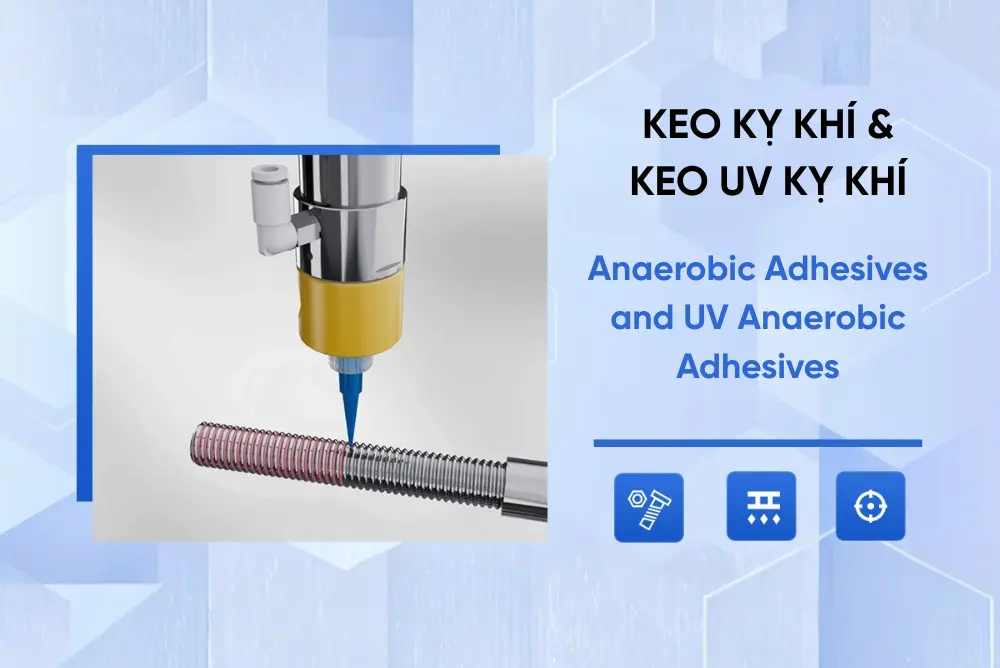
Anaerobic Adhesives and UV Anaerobic Adhesives for Thread Locking, Metal Sealing, and Fast Positioning

A technical overview of anaerobic and UV anaerobic adhesives, covering working principles, advantages, applications in automation.

23 Dec 2025
Admin
2 minutes read
Anaerobic Adhesives and UV Anaerobic Adhesives for Thread Locking, Metal Sealing, and Fast Positioning

As industrial manufacturing increasingly demands high precision and optimized efficiency, selecting the right industrial adhesive is no longer just a quality issue. It directly impacts productivity, process stability, and overall operating costs across the entire production line. 

Among today’s most widely adopted solutions are anaerobic adhesives and UV anaerobic adhesives.

What Is an Anaerobic Adhesive and Why Is It Critical in Manufacturing?

Anaerobic adhesive is a single-component liquid adhesive that cures only when oxygen is excluded and metal ions are present. Curing occurs exclusively within the confined gap between two metal surfaces, forming a durable and long-lasting bond.

Key Characteristics of Anaerobic Adhesives

  • Cures only in sealed metal-to-metal gaps.
  • Ideal for thread locking, metal surface sealing, and internal component fixation

Curing Mechanism of Anaerobic Adhesives

  • Anaerobic adhesives consist of monomers and initiators. When exposed to air, the adhesive remains liquid and does not cure. 
  • Once applied between two metal surfaces, oxygen is eliminated. Metal ions activate the initiator, triggering polymerization. Monomers continuously link together to form a three-dimensional polymer network, resulting in full curing.
  • Result: a strong, stable bond between metal surfaces.

Key Advantages of Anaerobic Adhesives

  • Fast curing in confined metal joints without heat or additional catalysts
  • High mechanical strength and durability, with resistance to shear, tensile loads, vibration, heat, oils, and chemicals
  • Easy to use and suitable for mass production. As a one-component adhesive, it can be applied directly and works well in both manual operations and automated lines
  • High dispensing accuracy when combined with diaphragm valves and precision metering systems, ensuring repeatability and uniformity

What Is a UV Anaerobic Adhesive?

UV anaerobic adhesive is an advanced version of anaerobic adhesive that combines two curing mechanisms:

  • UV surface curing: UV exposure instantly cures the outer layer within seconds, providing immediate fixation after assembly.
  • Anaerobic internal curing: The adhesive inside the joint continues to cure anaerobically, ensuring complete and durable bonding.

This dual mechanism enables rapid fixation even when part of the bonded surface is not metal or remains exposed to air.

Advantages of UV Anaerobic Adhesives

  • Flexible dual-cure behavior for assembly efficiency. UV curing provides immediate handling strength, allowing operators or robots to proceed without waiting, while anaerobic curing ensures long-term reliability
  • Compatible with multiple materials, including metal, glass, and transparent plastics such as PC and PMMA
  • Higher automation throughput by reducing waiting time and reliance on fixtures, saving both time and floor space
  • Broad application range, including electronics manufacturing, consumer goods, automotive components, and medical devices

Typical Applications of Anaerobic and UV Anaerobic Adhesives

Application Description
Thread locking Fills thread gaps to prevent loosening and leakage, replacing mechanical locking methods
Metal surface sealing Used in pumps, valves, and gearboxes without gaskets
Bonding dissimilar materials Metal-to-glass and metal-to-transparent plastic bonding
Electronics assembly Micro-dispensing for lenses, display modules, and device housings
Automated production lines Fast curing and precise dispensing improve productivity

Common Issues in Anaerobic Adhesive Dispensing and Their Causes

Incomplete curing:

  • Cause: presence of oxygen or insufficient metal ions due to non-metal surfaces or heavily oxidized metals
  • Solution: ensure gaps are fully filled, eliminate air pockets, or use UV anaerobic adhesive when one or both surfaces are non-metallic

Adhesive overflow or inconsistent volume:

  • Cause: poor dispensing control or unstable valve performance
  • Solution: use high-precision dispensing valves

Inconsistent thread locking strength

  • Cause: inaccurate adhesive placement, incomplete thread coverage, or improper system calibration
  • Solution: use precision dispenser units and high-accuracy dispensing valves

Slow curing or weak initial strength

  • Cause: low ambient temperature or low surface reactivity.
  • Solution: maintain suitable ambient temperature. Allow sufficient curing time, especially for low-reactivity substrates such as stainless steel or aluminum

Recommended Adhesive Dispensing Equipment Configuration

To fully leverage the performance of anaerobic and UV anaerobic adhesives, dispensing systems must be precise, stable, and drip-free. Below are Temas’ recommended solutions.

SV62 – High-Precision Diaphragm Dispensing Valve

Suitable for: anaerobic adhesives, thread lockers, medium- to low-viscosity sealants

Technical Features:

  • Material-isolated structure prevents adhesive backflow.
  • Fast, accurate on/off control with excellent anti-drip performance.
  • Adjustable needle for micro-dot applications.
  • UHMW polymer wetted chamber and diaphragm valve are best for reactive materials

Applications:

  • Screw locking, bearing fixation, metal joint sealing.
  • Easy integration with dispensing robots and automated systems.

Benefits:

  • Reduced adhesive waste through precise volume control.
  • Improved consistency and reduced defects.

Product: High Precision Diaphragm Valve for Dispenser San-ei Tech SV62

SV62-B – Light-Shielded Diaphragm Dispensing Valve

Suitable for: UV anaerobic adhesives, UV adhesives, optical epoxies

Technical Features

  • Black UHMW valve body for effective UV shielding.
  • Fast and precise switching with stable micro-dispensing.
  • Compact design for high-speed robotic systems.
  • UHMW polymer wetted chamber and diaphragm valve are best for reactive materials

Applications:

  • UV pre-curing processes
  • Camera modules, transparent plastic housings, optical and electronic components.

Benefits:

  • Completely prevents premature curing and clogging.
  • Stabilizes production lines and reduces downtime.

Product: Diaphragm Valve with Black Cover for Dispenser San-ei Tech SV62-B

SRD250 – Rotary Tubing Dispenser

Suitable for: anaerobic adhesives, UV anaerobic adhesives, oils, technical fluids.

Technical Features:

  • High-precision micro-adjustment knob
  • Suck-back mechanism to prevent dripping
  • Proprietary rotary structure reduces air bubbles and mechanical load, extending tube life
  • Built-in cycle counter
  • RS232 communication for PLC integration.

Applications:

  • Single-point dispensing
  • R&D processes and high-mix, low-volume production lines

Benefits:

  • Consistent dispensing volume per cycle
  • Reduced dependency on operator skill

Product: Rotary Tubing Dispenser San-ei Tech SRD250
 

Anaerobic adhesives are ideal for high-strength, load-bearing, long-term metal bonding. UV anaerobic adhesives offer a more advanced solution when fast positioning, multi-material bonding, and automated line optimization are required.

Temas supplies high-quality Japanese adhesive dispensing equipment and integrated solutions, including San-Ei Tech dispensing systems, Janome tabletop dispensing robots, Tsutsumi dispensing robots, and turnkey dispensing system design and integration.

Contact us to develop a dispensing solution tailored to your production requirements

Last modified on: 23 Dec 2025

Don't forget to share this post!

Related Articles