 Nội dung
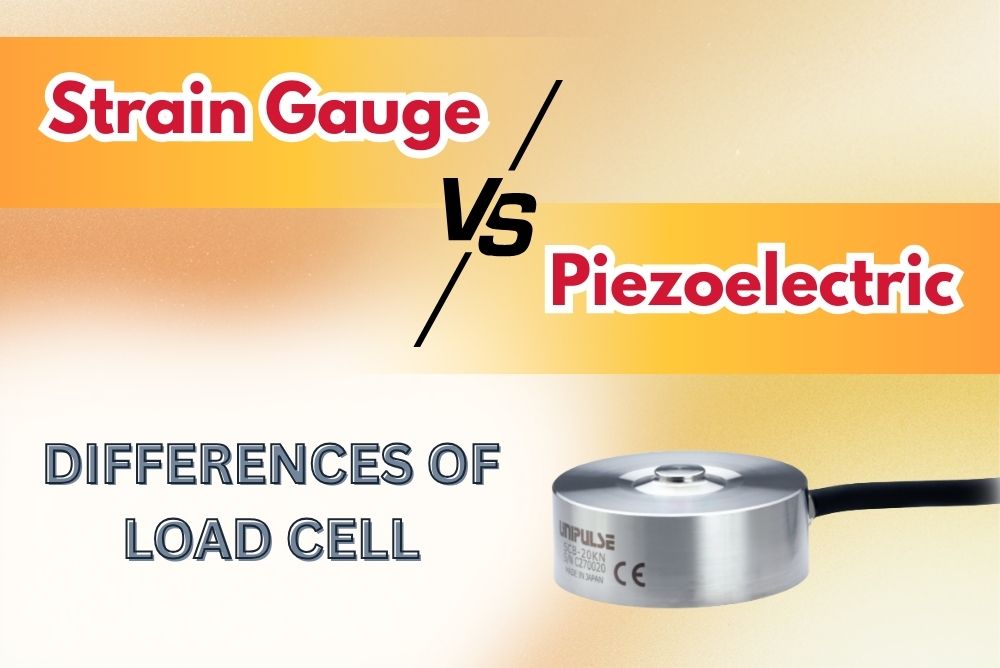
This article explains the technical differences between strain gauge type and piezoelectric type load cells, focusing on operating principles, performance characteristics, and suitable applications.
Strain Gauge Type Load Cell
The strain gauge type utilizes the elastic properties of metals.
When a force is applied, the metal element elastically deforms, and the resulting strain is detected by strain gauges and converted into an electrical signal.
Within the elastic range, strain is directly proportional to stress, as shown in the force–elongation relationship. This elastic range is the usable region for force and load measurement.

Advantages of Strain Gauge Type Load Cell
- Excellent creep properties: Even when the same load is continuously applied, the output shows hardly any fluctuation over time.
- High signal stability: Suitable for static load measurement and long-term force monitoring.
- Reliable accuracy: Well-suited for weight measurement, press force measurement, and general industrial force sensing
- Easy calibration and traceability: Suitable for measurement systems requiring stable and repeatable results.
Disadvantages of Strain Gauge Type Load Cell
- Lower responsiveness for momentary loads: Compared with piezoelectric type load cells, responsiveness is lower when measuring impact forces or very short-duration loads.
Piezoelectric Type Load Cell
The piezoelectric type uses a piezoelectric element that generates an electric charge when force is applied.
- Under compression force, a larger voltage is generated
- Under tensile force, a smaller voltage is generated

Advantages of Piezoelectric Type Load Cell
- High rigidity with minimal deflection, allowing less deflection and very high responsiveness.
- Excellent for high-speed dynamic force measurement
Disadvantages of Piezoelectric Type Load Cell
- Poor creep properties: Even under a constant load, the output fluctuates over time due to charge leakage.
- Not suitable for static load measurement
- Unsuitable for:
- Continuous load testing
- Accurate hysteresis measurement of components such as springs or dampers
Summary: Strain Gauge vs. Piezoelectric Load Cells
| Criteria | Strain Gauge Type | Piezoelectric Type |
| Operating principle | Elastic deformation of metal | Piezoelectric effect |
| Static load measurement | Highly suitable | Not suitable |
| High-speed dynamic force | Moderate responsiveness | Excellent responsiveness |
| Creep properties | Excellent creep properties | Poor creep properties |
| Signal stability over time | High | Low |
| Typical applications | Weighing, press force measurement, load measurement | Impact force, shock and impulse measurement |
Which Type of Force Sensor Should You Choose?
Strain Gauge Force Sensors
- Suitable for both static and dynamic load measurement
- Typical applications:
- Press force measurement
- Tensile force measurement
- Force control in assembly and testing processes
Piezoelectric Force Sensors
- Suitable for high-speed dynamic force measurement
- Typical applications:
- Impact force measurement
- Shock and impulse measurement
- Not suitable for static load measurement or long-duration tensile force measurement
Japanese Force Sensors from Temas
Temas supplies a wide range of strain gauge force sensors from UNIPULSE (Japan), featuring:
- Compact mechanical design
- High rigidity with fast responsiveness
- Excellent repeatability, suitable for high-precision industrial force measurement systems.
Ultra-thin Compression Type Load Cell UST
- Ultra-compact load cell with 2.3 mm height and φ10 mm diameter.
- Convenient for retrofitting into existing machines.
- Ideal for load distribution measurement using multiple sensors.

Thin Washer Type Load Cell UWP
- Thin washer-type load cell with 8 mm height.
- Ideal for measuring screw axial force and fastening force.
- Allows positioning pins or wiring to pass through the center.

High Stiffness Strain Gauge Type Load Cell SCB
- A “hardly breakable” load cell, unique to UNIPULSE
- Force range: 100 N to 200 kN
- Achieves phenomenal rigidity and high responsiveness
- High responsiveness with natural frequency up to 40 kHz
- Safe overload capacity up to 500%, making it extremely durable
- Suitable not only for press load measurement but also for impact and destructive testing

Temas is the authorized distributor of UNIPULSE in Vietnam, specializing in force, weight, and torque measurement solutions, including load cells, indicators, weighing systems, and signal converters.
Explore more UNIPULSE products here.



 Read more