 Nội dung
When developing an automation solution, engineers must evaluate more than just price and brand. Understanding each robot’s working principle, payload capability, programming complexity, and integration requirements is essential to selecting the right system.
Two of the most commonly considered options today are desktop robots and articulated robots. While both are widely used in industrial environments, they serve very different purposes.
This article provides a clear, engineering-focused comparison to support your decision-making process.

Overview of Desktop Robots and Articulated Robots
What Is a Desktop Robot?
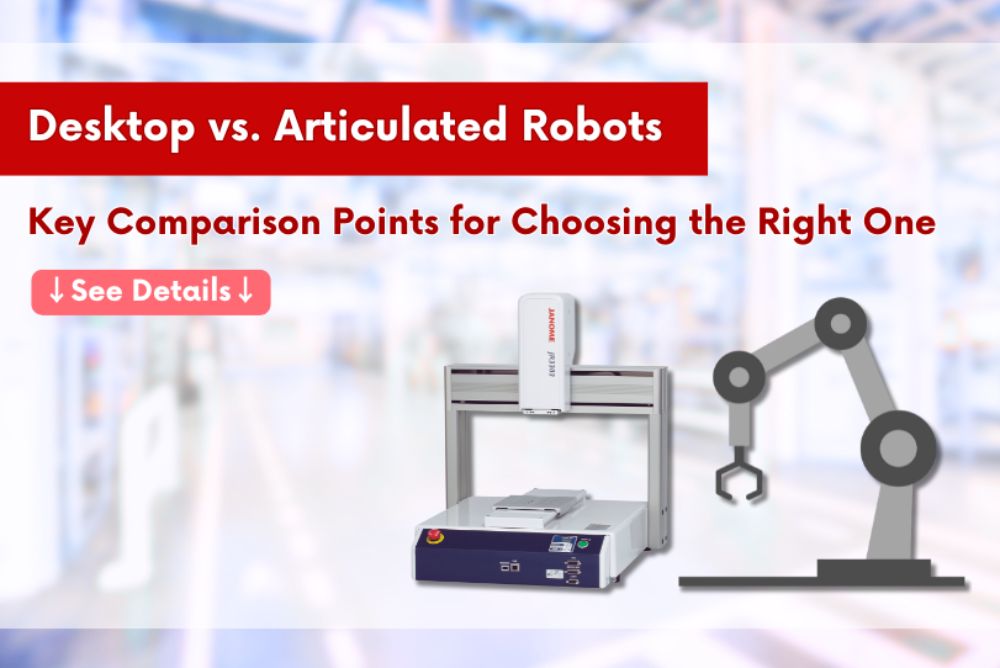
A desktop robot operates on a Cartesian X-Y-Z coordinate system, where the workpiece is placed on an X-table and the tool head moves along linear axes.tem X-Y-Z). This linear structure gives desktop robots a distinct advantage in applications that demand precise and repeatable motion control.

Some desktop robot models from Janome (Japan): standard model, dispensing model, screw tightening model, etc.
Key Advantages
- High-precision path control: The simple linear-axis structure ensures excellent positioning accuracy and repeatability.
- Simple configuration and operation: With only three linear axes, setup and parameter configuration are straightforward. Many tasks can be programmed using coordinate input rather than complex coding.
- Compact design and easy integration: Desktop robots require minimal floor space and can be deployed quickly.
- Lower initial investment cost
Limitations
- Limited flexibility in complex 3D motion
- Lower payload capacity, typically up to 15–20 kg
- Not ideal for large or heavy workpieces
Typical Applications
Desktop robots are widely used in high-precision processes such as:
- Precision dispensing
- Soldering operations
- PCB depaneling using router cutting
- Screwdriving and small-part assembly
For repetitive, path-sensitive tasks, desktop robots often provide the most efficient and cost-effective solution.
What Is an Articulated Robot?
Articulated robots are multi-joint robotic arms designed to replicate the flexibility of a human arm. Standard configurations include 4-axis and 6-axis systems, though more complex setups may include additional axes.
Their rotary joint structure enables complex spatial motion and dynamic tool orientation.

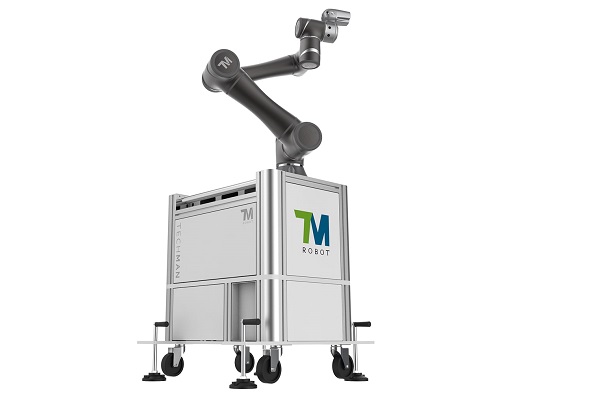
Some arrticulaed robot models: Techman Cobot, Epson 6-axis robots
Key Advantages
- High flexibility: Multiple joints allow the robot to reach various angles and positions within a 3D workspace.
- Wide payload range: Models are available from light-duty systems to heavy-duty units capable of lifting automotive body structures.
- Suitable for continuous production systems: Particularly effective in conveyor-based and high-volume manufacturing environments.
Limitations
- More complex programming requirements
- Higher hardware and integration cost
- Greater maintenance complexity due to multiple joint mechanisms
Typical Applications
Articulated robots are commonly used in:
- Automotive welding and painting
- Pick and place systems
- Assembly lines
- Palletizing operations
- Material handling in conveyor-based systems
Read more: 7 types of industrial robots: Definition, classification and applications
Desktop Robot vs. Articulated Robot: A Side-by-Side Comparison
Both robot types offer distinct advantages depending on the production requirements.
| Criteria | Desktop Robot | Articulated Robot |
| Typical Applications |
|
|
| Payload Capacity |
(*JANOME Desktop Robot JR4000Series, JR3000Series, 3-Axes Specification) |
Wide range from small to very large (e.g., models that lift entire car bodies) |
| Cost / Price Range | Relatively low cost | Generally high cost |
| Installation Requirements | Ready to use with minimal setup | Requires installation work and setup |
| Startup and Setup Time | Quick, in some cases, setup can be done in-house | Typically requires integration by a system integrator (SIer) |
| Required Technical Expertise | Simple tasks can be configured and operated without coding (via position & parameters) | Requires programming knowledge |
| Strengths / Specialization | Ideal for high-precision, small-scale operations with accurate path control | Multi-axis flexibility enables dynamic tool orientation and complex motion handling |
Note: The JR3000 series with a Heavy-Duty specification can handle workpieces up to 20 kg.
Overview – Fundamental Knowledge of Janome Desktop Robots
The Basic Structure of Desktop Robots, 5 Key Criteria for Selecting a Desktop Robot, and a Comparison Between Desktop Robots and Articulated Robots – All in One Document!
DOWNLOAD PDF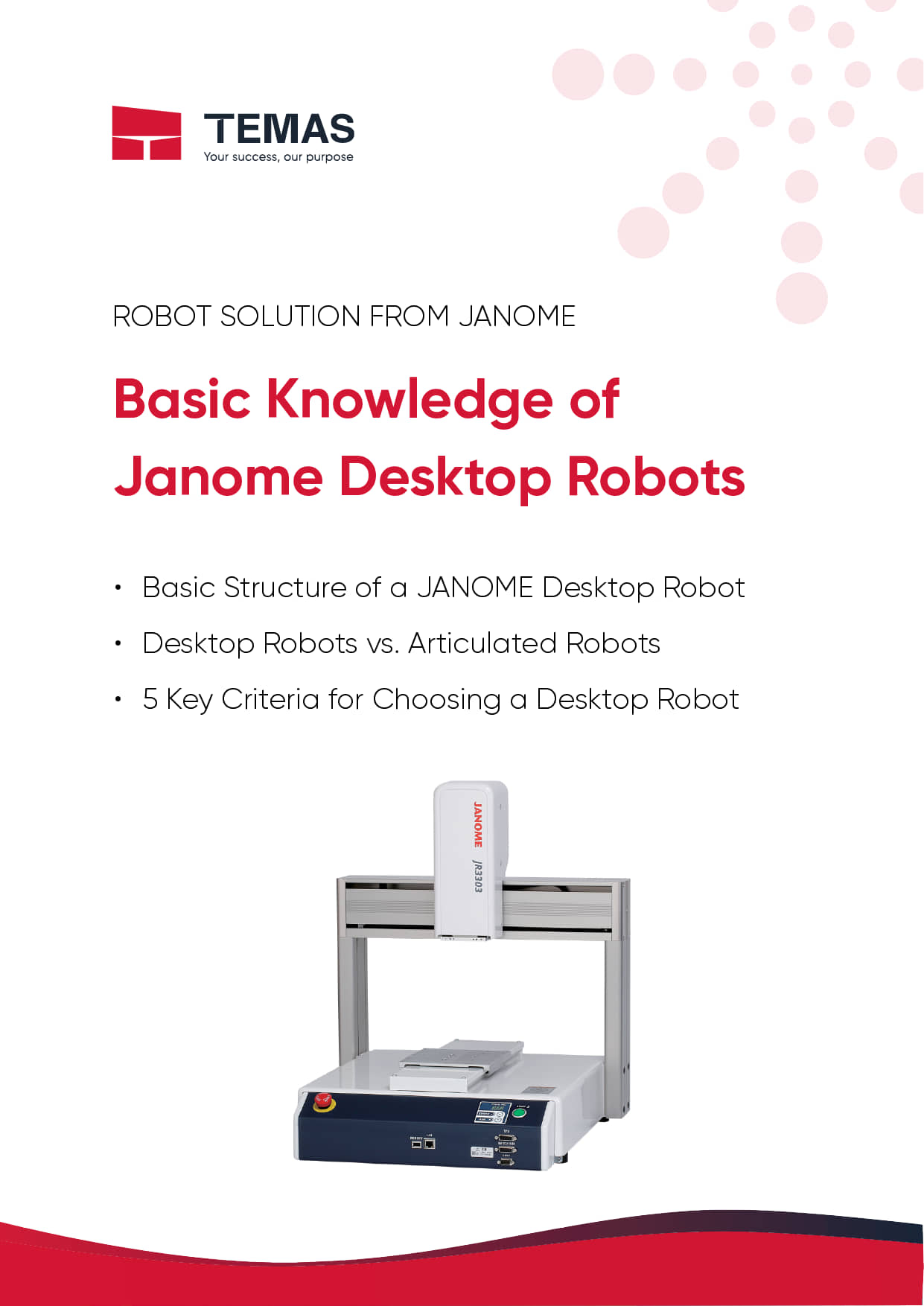
How to Choose the Right Robot for Your Factory
Selecting the right robot depends on your application priorities.
Choose a desktop robot if your process requires:
- High path accuracy
- Stable and repeatable operations
- Precision dispensing, soldering, screw fastening, or PCB processing
- Fast deployment with optimized cost
Choose an articulated robot if your production demands:
- Multi-directional flexibility
- Complex 3D motion
- Conveyor integration
- Handling of large or heavy workpieces
Temas is an official distributor of Janome desktop robots, Tsutsumi robots (Japan), Epson industrial robots, and Techman collaborative robots (Taiwan). If you are evaluating robot solutions or planning a new automation project, our engineering team is ready to support you with consultation and system integration expertise.



 Read more